

Travel memory wall art is defined as personalized home decor that combines photography, keepsakes, and printed art to turn your journeys into a living story on your walls. These displays go far beyond a framed photo. They are memory maps, conversation starters, and daily reminders of the places that shaped you. The best travel memory wall art display ideas blend emotional storytelling with materials built to last, so your walls feel collected and effortless rather than cluttered or generic.
1. Creative shadow box ideas for displaying travel keepsakes
Shadow boxes are one of the most expressive travel art display ideas available, because they hold both flat and three-dimensional objects in a single, unified frame. A ticket stub from Lisbon, a dried flower from a Kyoto garden, and a small ceramic tile from a dusty market can all live together in one shadowbox, telling a story no single photo could.
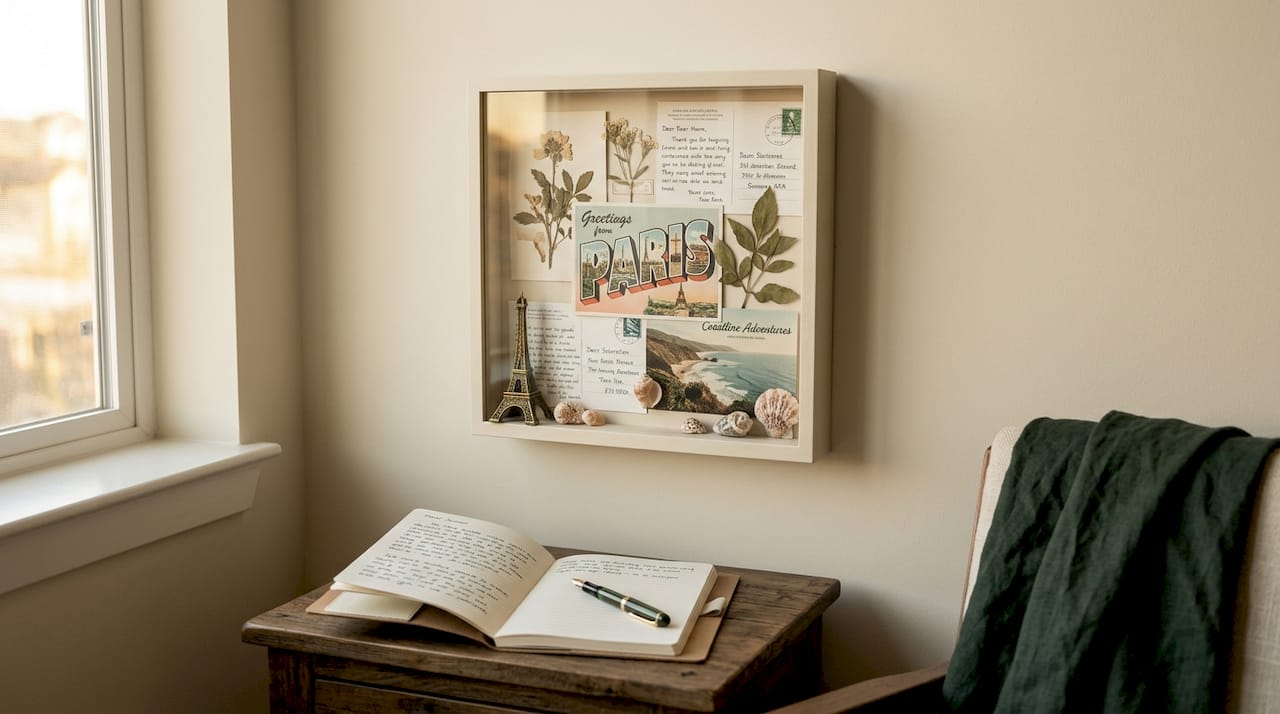
Interior depth is the first decision you make. Boxes with 1.5 to 2 inches of depth work well for flat items like postcards, maps, and pressed botanicals. Bulkier souvenirs, like a folded jersey or a carved figurine, need 3 to 4 inches of clearance to sit without pressing against the glass. Getting this wrong means crushed keepsakes and a display that looks amateur rather than artful.
The layering technique matters just as much as the frame itself. Flat paper items go in the back, with a larger 3D focal piece placed in the foreground. This prevents the display from reading as a flat, cluttered collage and gives the eye a clear place to land. A vintage map as the background layer adds geographic context and warm color without competing with the objects in front.
- Use a vintage map of the destination as your background layer
- Arrange tickets, receipts, and postcards chronologically from left to right
- Place your most textured or three-dimensional souvenir as the central focal point
- Secure flat paper items with archival photo corners to prevent fading and physical damage over time
Pro Tip: Use acid-free archival materials throughout your shadow box. Standard adhesives and backing boards off-gas chemicals that yellow paper and degrade photographs within a few years.
2. Comparing photo print types for durable travel wall art
The print material you choose determines how long your travel memories stay vivid on the wall. This is not a minor aesthetic decision. It is a preservation choice.
ChromaLuxe metal prints last 65 or more years with excellent resistance to UV light, humidity, and scratches. That rating comes from independent testing, and it means a metal print hung in a coastal home with salt air and strong afternoon light will still look sharp decades from now. Canvas prints, by contrast, can fade visibly within 5 to 10 years without protective coatings, making them a less reliable choice for high-light environments.
Acrylic prints offer a third path. They deliver sharp color clarity and a glass-like finish that reads as modern and gallery-quality. They are more durable than standard canvas but generally do not match the longevity of metal.
| Print type | Estimated lifespan | Best environment | Maintenance |
|---|---|---|---|
| Metal (ChromaLuxe) | 65+ years | Any, including coastal | Wipe clean, no coating needed |
| Canvas | 5 to 25 years | Low-light, dry interiors | Requires UV-protective coating |
| Acrylic | 20 to 40 years | Modern, well-lit spaces | Occasional dusting, avoid abrasives |
Pro Tip: For travel photos that capture strong light, like desert sun or ocean reflections, metal prints reproduce those highlights with a luminosity that canvas simply cannot match.
3. Gallery walls and photo maps: arranging travel memories visually
A gallery wall becomes a memory wall decor system when it is built around a theme rather than assembled randomly. Focusing one wall on a single trip, a specific region, or a recurring experience like coastlines or markets gives the display a coherent narrative. Guests do not just see photos. They follow a story.
Themed gallery walls work with either consistent framing for a calm, editorial feel or eclectic frames in varied sizes and finishes for a more personal, collected look. Neither approach is wrong. The choice depends on whether you want the wall to feel like a curated exhibition or a beloved scrapbook. Photo maps take this further by letting you insert actual images at the geographic locations you visited, turning the wall into an interactive tracker and conversation piece.
Consider these practical tips when building your travel photo collage ideas into a gallery wall:
- Choose a high-traffic location like an entryway or living room so the display gets seen and sparks conversation daily
- Start with your largest print as an anchor, then build outward with smaller pieces
- Mix place-evocative wall art with personal photos to add visual variety and emotional depth
- Leave 2 to 3 inches of consistent spacing between frames for a clean, intentional look
4. Using curio cabinets and 3D displays for travel memorabilia
Curio cabinets transform a collection of small souvenirs into a personal art gallery, offering protection from dust and damage while keeping every piece visible. This matters for travelers who accumulate small, fragile objects: a hand-painted thimble from Prague, a tiny brass compass from a Marrakech souk, a smooth stone from a Norwegian fjord.
The most effective curio displays are organized by theme, era, or color rather than crammed in by acquisition date. A shelf dedicated entirely to objects from one country reads as intentional. A shelf mixing unrelated items from a dozen trips reads as storage. Lighting is the detail most people overlook. A small LED strip inside the cabinet shifts the display from furniture to focal point, casting warm light across textures and colors that would otherwise disappear in shadow.
- Group objects by destination, material, or color palette for visual coherence
- Add a small printed label or handwritten card to identify the origin of each piece
- Use glass shelving where possible to let light pass through the full cabinet
- Consider open shelving with individual glass cloches as a more modern alternative to a traditional cabinet
Pro Tip: Treat your curio cabinet like a rotating gallery. Swap pieces in and out seasonally to keep the display feeling fresh and to give rarely seen objects their moment.
5. DIY travel art and memory walls: personalizing your display
Getting travel photos off your phone and into physical formats makes memories more vivid and approachable. A digital photo buried in a camera roll does not hold the same emotional weight as a printed image on your wall, framed and lit and seen every morning.
Here are five DIY travel art approaches that go beyond a standard print-and-hang:
- Create a travel story corner. Dedicate a small wall section or shelf to one trip, combining a printed photo, a souvenir, a handwritten caption, and a small map. This format tells a complete story in a compact space.
- Use personalized frames. Engrave or hand-letter the destination and date on a simple frame. The frame itself becomes part of the memory, not just a border around it.
- Arrange chronologically. Line frames along a hallway in the order you traveled, turning a corridor into a timeline of your life’s adventures.
- Add journaling cards. Tuck a small card behind or beside each print with a sentence or two about the moment. Guests who ask about a photo get the full story, not just the image.
- Incorporate a digital frame. A rotating digital display alongside physical prints lets you cycle through hundreds of travel photos without cluttering the wall, and it works as a modern complement to a curated physical gallery.
Key takeaways
The most meaningful travel memory wall art combines durable print materials, thoughtful layering, and personal storytelling elements that keep your journeys alive on the wall for decades.
| Point | Details |
|---|---|
| Match shadow box depth to your tallest souvenir | Use 1.5 to 2 inches for flat items and 3 to 4 inches for bulkier three-dimensional keepsakes. |
| Choose metal prints for longevity | ChromaLuxe metal prints last 65 or more years and resist UV, humidity, and scratches better than canvas. |
| Build gallery walls around a theme | A single trip, region, or visual motif gives your wall a narrative rather than a random collection of images. |
| Curio cabinets need lighting | LED lighting inside a cabinet transforms a storage piece into a display that reads as intentional and gallery-quality. |
| Start small and build over time | A single shadow box or a trio of prints is a stronger starting point than trying to fill an entire wall at once. |
Why your walls deserve the same care as your travel journal
We have seen a lot of travel memory walls over the years, and the ones that genuinely move people share one quality: they were built slowly and with intention. The walls that feel cluttered or forgettable were usually assembled quickly, with whatever frames were on sale and whatever photos were easiest to print.
The counterintuitive truth is that less is almost always more. One beautifully printed metal photograph of a coastline you love, hung at the right height in the right light, does more emotional work than a grid of twenty mediocre prints. The same applies to shadow boxes. A single well-layered box from one meaningful trip tells a clearer story than five boxes crammed with everything from five different countries.
We also think the material choice is undervalued. Most people spend time choosing the photo and almost no time choosing the print format. But a canvas print that fades in a sunny room is a quiet disappointment every time you walk past it. A metal print in that same room stays sharp and luminous for decades. The photography versus souvenirs question is real, and for wall art specifically, a great photograph almost always outlasts and outperforms a physical object in terms of daily emotional impact.
Start with one wall, one trip, one format. Let it settle. Then add.
— Info
Bring your travel stories to life with Calicuration
Your travel memories deserve more than a phone camera roll. Calicuration creates wall art from original, founder-shot travel photography, printed on demand in formats built to last. Every piece captures a specific feeling: the glow of a coastal afternoon, the stillness of a desert road, the texture of a city at dusk.
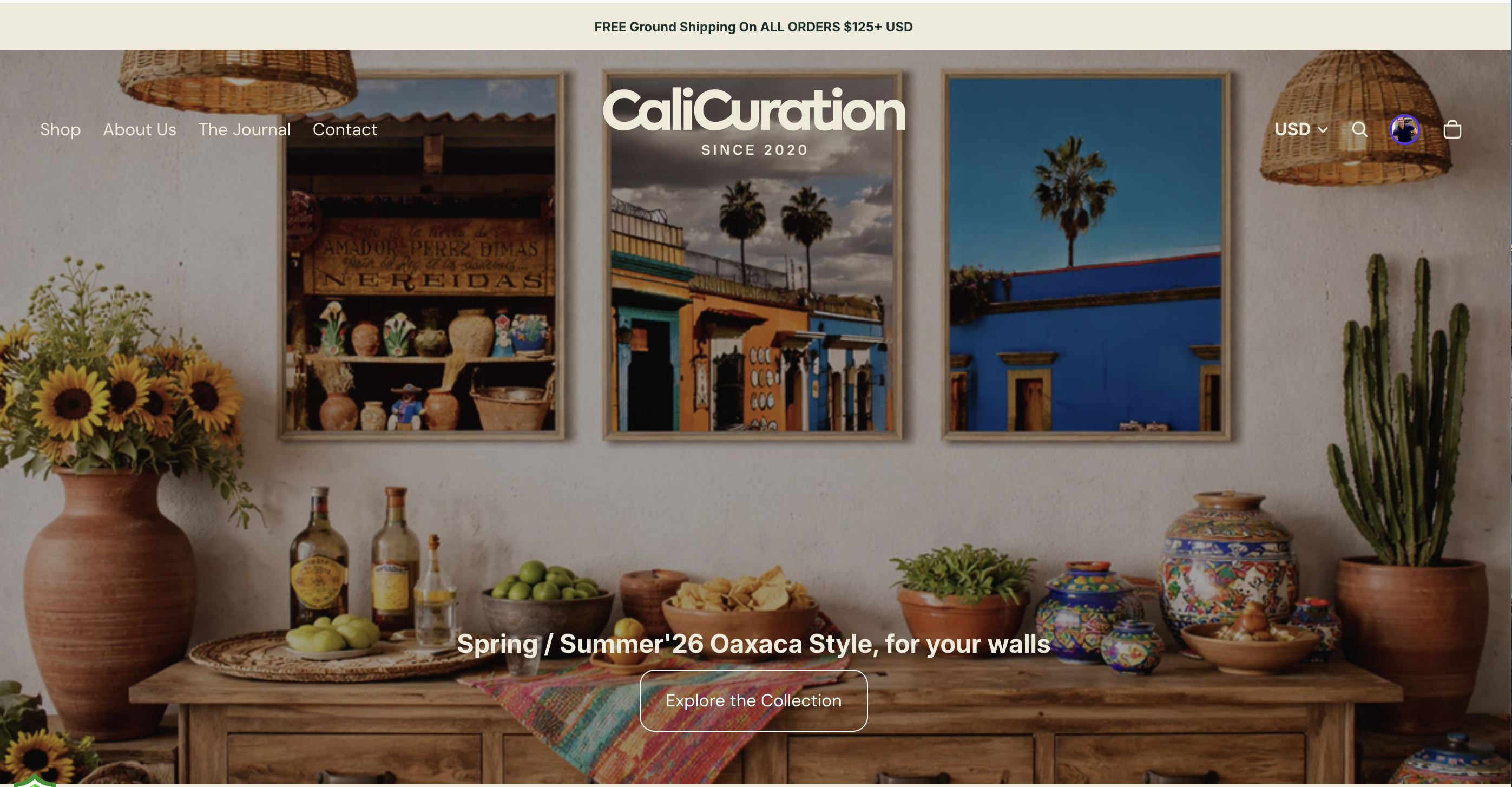
Browse Calicuration’s travel photography collection to find metal prints, canvas art, and framed pieces that complement your own memory displays. Whether you are building a gallery wall, anchoring a shadow box arrangement, or looking for one statement piece, the collection offers story-driven art that makes any space feel warmer and more personal. Each purchase also supports community impact efforts in Los Angeles and New York City, because giving back has been part of the brand since day one.
FAQ
What is travel memory wall art?
Travel memory wall art is personalized home decor that combines travel photography, printed art, and keepsakes to display your journeys as a visual story on your walls. It includes formats like shadow boxes, gallery walls, photo maps, and framed prints.
How do I choose the best print material for travel photos?
Metal prints, particularly ChromaLuxe panels, are the most durable option, lasting 65 or more years with resistance to UV light and humidity. Canvas prints are a softer, more traditional look but fade faster without protective coatings.
How deep should a shadow box be for travel souvenirs?
A shadow box with 1.5 to 2 inches of depth works for flat items like postcards and tickets. Bulkier souvenirs like small figurines or folded textiles need 3 to 4 inches of interior clearance to display properly without pressing against the glass.
Where should I hang a travel gallery wall?
High-traffic areas like entryways, living rooms, and hallways are the best locations for travel gallery walls. These spots maximize daily visibility and give the display the most opportunity to spark conversation and reconnect you with your memories.
Can I mix personal photos with purchased travel art?
Mixing personal travel photos with professionally printed travel art creates a richer, more layered display. The combination adds visual variety and lets you fill gaps in your own photography with art that captures a similar mood or place.