

Some rooms feel lived in. Others feel lived. The difference is often a single wall that tells a story. Finding examples of place-evocative wall art that genuinely connects to your life, rather than simply filling space, is harder than it sounds. You want something that carries the salt air of a coast you love, or the amber glow of a city you once called home. This article walks you through the criteria that matter when choosing place-inspired art, then gives you specific, inspiring examples across maps, travel photography, mixed media, and cityscapes, so you can build walls that feel like yours.
Table of Contents
Key takeaways
| Point | Details |
|---|---|
| Scale before style | Size your art to furniture first using the two-thirds rule before choosing subject or color. |
| Light shapes everything | Natural light cycles affect both mood and longevity, so assess your room before hanging. |
| Maps carry personal weight | Custom map prints with dates or coordinates transform a wall into a memory. |
| Layers create depth | Mixing photographs, frames, and mementos builds richer place stories than single pieces alone. |
| Match palette, not theme | Art color should echo room accents, not replicate them exactly, for a collected feel. |
1. How to choose place-evocative wall art that actually works
Before you fall for a print, study the room it will live in. Designers advise reading how light moves through a space across the day, how the room is used, and what mood it already holds. A piece that glows in a gallery can feel cold and flat in a north-facing bedroom.
Here are the core criteria worth considering before you buy:
-
Scale and proportion. The two-thirds rule is your most reliable starting point: art should span roughly two-thirds the width of the furniture beneath it. A narrow print above a king bed looks lost. A wide panoramic above a loveseat grounds the whole room.
-
Natural light and material sensitivity. Works on paper and photography are vulnerable to UV fading. If your wall gets strong afternoon sun, choose canvas prints or UV-protective glazing rather than unprotected paper.
-
Color harmony. Art should balance with room accents without clashing or disappearing into them. Pull one or two tones from your existing textiles and look for art that echoes, not copies, those hues.
-
Narrative fit. Ask whether the place in the artwork means something to you. The most memorable examples of place-evocative wall art are the ones that carry a personal story, not just a pretty image.
-
Durability and placement. Canvas holds up better in humid spaces like kitchens. Framed prints work beautifully in drier rooms where you can control light exposure.
Pro Tip: Photograph your room in morning and afternoon light, then hold a printed color swatch against the wall. How the light changes the swatch tells you exactly how it will change your art.
2. Custom city and country map prints
Map art is one of the most quietly powerful examples of place-evocative wall art you can choose. A well-designed map does not just show a location. It holds a feeling, a time, a reason you were there.
Wide panoramic map prints work especially well as statement pieces above sofas or beds, where they visually anchor the room without competing with smaller décor. The scale gives them authority. The subject gives them warmth.
What makes map art so versatile:
-
Minimalist vs. detailed styles. A clean, single-color street map of your neighborhood reads as modern and graphic. A richly detailed topographic map of a national park feels more organic and textured. Both work, depending on your room’s personality.
-
Custom typography and coordinates. Personalized map prints with a wedding date, a set of coordinates, or a city name in your chosen font turn a beautiful print into something irreplaceable. No one else has that exact piece.
-
Color themes. Navy and gold reads classic. Black and white reads architectural. Warm terracotta and cream reads collected and well-traveled. Choose a palette that speaks to your room, not just the geography.
-
Gallery wall pairings. A large city map paired with two or three smaller travel photos from that same trip creates a cohesive wall story without feeling like a scrapbook.
Pro Tip: Order a map of a place you are planning to visit, not just places you have been. Hanging it before the trip builds anticipation, and after the trip it carries a whole new layer of meaning.
3. Travel photo collages and mixed media gallery walls
A single photograph is a moment. A gallery wall is a life. When you layer framed travel photos with maps, postcards, and small keepsakes, you build something that feels genuinely collected rather than decorated.
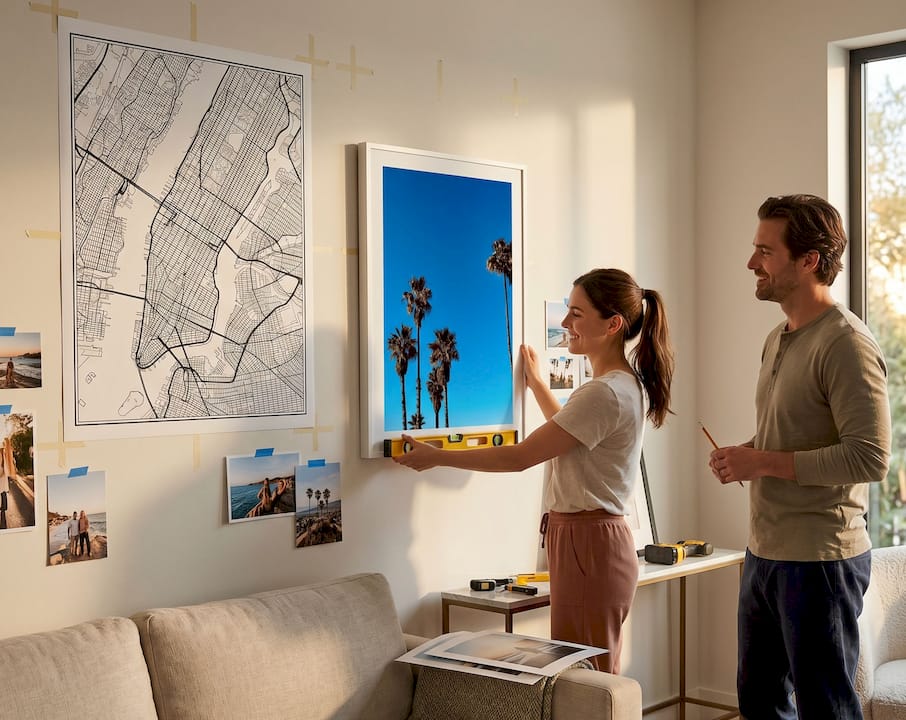
Mixing maps with travel photos and small mementos in coordinated frames is one of the most personal forms of place-themed home decor available. The key is choosing a unifying thread so the wall reads as intentional, not cluttered.
Here is how to build a travel gallery wall that holds together:
-
Choose 2 to 3 frame finishes. Black, natural wood, and antique gold work well together. More than three finishes and the wall starts to feel restless.
-
Vary the sizes deliberately. One large anchor piece, two medium prints, and three or four smaller frames creates rhythm. Uniform sizing makes the wall feel like a grid, which can feel cold for travel-themed art.
-
Incorporate shadow boxes. Shadow boxes with tickets, postcards, and pressed flowers alongside framed photos add tactile depth. A dried flower from a market in Provence or a ferry ticket from a Greek island carries more emotional weight than almost any print you could buy.
-
Build around a theme. “The places we got lost” or “Every coastline we have stood on” gives the wall a narrative spine. Themes help you edit ruthlessly, which is what separates a great gallery wall from a chaotic one.
-
Stick to 2 to 3 main colors. Coordinating colors and frames across diverse elements unifies the wall and keeps it feeling like a curated collection rather than a bulletin board.
4. Artistic cityscape paintings and prints
There is something about a city skyline that holds both intimacy and scale at once. You can feel small looking at it, and completely at home. Cityscape art is among the best place-based artwork for living rooms, home offices, and dining spaces because it carries mood as much as geography.
Oversized cityscape paintings or prints work as dramatic focal points in rooms that need a strong visual anchor. A large canvas of a city at dusk, with its warm golds and deep blues, can set the emotional temperature of an entire room.
Consider these stylistic directions when choosing cityscape art:
-
Realistic photography prints capture the actual texture of a city: the reflection of lights on wet pavement, the geometry of fire escapes, the haze over a harbor at dawn. These work especially well for people who have a deep personal connection to a specific city.
-
Watercolor cityscapes soften hard urban lines and give the art a dreamy, remembered quality. They suit bedrooms and reading nooks where you want atmosphere over precision.
-
Minimal line art reduces a skyline to its essential silhouette. This style reads as graphic and modern, pairing well with clean interiors and neutral palettes.
-
Abstract interpretations use color fields and gestural marks to evoke a city’s energy rather than its literal form. Think of the feeling of New York at midnight rather than its skyline.
Pro Tip: When hanging a large cityscape, position it so the horizon line in the artwork sits at roughly eye level when seated. This grounds the piece and makes the room feel like you are actually looking out at the view.
5. Comparison of place-evocative wall art types
Choosing between art styles is easier when you see them side by side. Here is a structured look at the most popular examples of travel wall art and creative location-inspired designs, and where each one shines.
| Art type | Best room fit | Narrative potential | Style versatility | Durability note |
|---|---|---|---|---|
| Custom map prints | Living room, bedroom, entryway | Very high: dates, coordinates, personal text | High: minimal to detailed, many color palettes | Good: canvas holds well; paper needs UV protection |
| Travel photo collages | Hallway, living room, home office | Very high: personal photos and mementos | Medium: depends on photo style and frame choices | Moderate: photos fade without UV glazing |
| Mixed media gallery walls | Living room, dining room, staircase | Highest: combines art, objects, and memory | High: mix of textures, frames, and scales | Varies: shadow box items need dry environments |
| Cityscape paintings or prints | Living room, office, dining room | High: city connection and mood evocation | Very high: realistic, watercolor, line art, abstract | Good: canvas is durable; paper needs care |
| Landscape and coastal photography | Bedroom, bathroom, sunroom | Medium to high: place and mood | Medium: depends on color palette and subject | Moderate: direct sunlight causes fading |
The table above is a starting point, not a rulebook. The best place-themed home decor decisions come from knowing your room and your story first, then finding the art that fits both.
My honest take on curating place-evocative art
I have spent years thinking about how art transforms a room, and the single mistake I see most often is choosing art for its beauty alone. A stunning print of somewhere you have never been and feel nothing for will always look like decoration. It will never feel like home.
What I have learned is that the emotional charge of a piece matters more than its technical quality. A slightly imperfect photograph from a trip that changed you will carry more weight on your wall than a flawless print of somewhere generic. The rooms I find most moving are the ones that feel like memory maps. Every piece has a reason to be there.
I have also learned that scale is the most underestimated factor in all of this. People consistently choose art that is too small. A piece that feels bold in a shop feels timid on a wall. Go larger than feels comfortable, and you will almost always be right.
The other thing worth saying: your walls should evolve. Do not treat them as finished. The best collections grow slowly, with intention, adding one meaningful piece at a time rather than filling every inch at once. That restraint is what makes a space feel collected rather than curated by committee.
— Info
Bring your walls to life with Calicuration
Calicuration was built around exactly this idea: that the places you love deserve a permanent place in your home. Every piece in the travel photography collection comes from original, founder-shot photography capturing California coasts, desert light, city glow, and destinations beyond. You will find ready-to-hang canvas prints, premium wooden framed posters, and coastal canvas art that bring the warmth of a specific place into any room. Each order is custom-produced on demand, and 5% of every purchase supports community impact in Los Angeles and New York City. Start by choosing one piece that genuinely moves you, and build from there.
FAQ
What makes wall art truly place-evocative?
Place-evocative wall art connects a viewer to a specific location through imagery, color, or personal meaning. The most effective examples combine visual authenticity with personal resonance, whether through a custom map, a travel photograph, or a cityscape that holds emotional significance.
How do I choose the right size art for my wall?
Use the two-thirds rule: art should span roughly two-thirds the width of the furniture beneath it. For walls without furniture, aim for a piece that fills 60 to 75 percent of the available wall space.
Can I mix different types of place-themed art on one wall?
Yes, and it often creates the richest result. Combining maps, photos, and mementos in coordinated frames builds a layered wall story. Stick to two or three frame finishes and a limited color palette to keep the display feeling cohesive.
Where should I avoid hanging photography or paper prints?
Avoid walls with direct sunlight exposure. Works on paper and photography are vulnerable to UV fading over time. Choose canvas prints for sun-exposed walls, or use UV-protective glazing on framed paper art.
What is the best place-evocative art for a bedroom?
Watercolor cityscapes, coastal photography, and custom map prints all work beautifully in bedrooms because they evoke mood and memory without visual noise. Choose softer palettes and subjects that feel restful rather than energizing for the best sleep-space results.