

Most people assume any framed print counts as statement wall art. It doesn’t. What is statement wall art, really? It’s a single, intentional piece that commands a room’s attention, anchors the space visually, and tells you something true about the person who lives there. It’s the difference between a wall that’s decorated and a wall that speaks. This guide breaks down the definition, the types, the design principles, and the room-by-room ideas you need to choose a piece that actually transforms your space rather than just filling it.
Table of Contents
- Key takeaways
- What is statement wall art, exactly?
- How statement art transforms a room
- Types of statement wall art worth knowing
- Design principles for placing statement art
- Statement wall decor ideas by room
- My honest take on statement art
- Find your statement piece with Calicuration
- FAQ
Key takeaways
| Point | Details |
|---|---|
| More than size alone | Statement wall art is defined by visual impact, emotional weight, and intentional placement, not just large dimensions. |
| Mood and focal point | A well-chosen piece sets room mood and creates a natural focal point that organizes the entire space. |
| Diverse types available | Statement art spans bold photography, 3D sculpture, typography, and found objects, far beyond traditional paintings. |
| The 57-inch rule matters | Centering art at eye level (around 57 to 60 inches from the floor) prevents pieces from feeling adrift on a wall. |
| Simplicity supports impact | Clearing competing visual elements around your statement piece keeps it powerful and prevents visual noise. |
What is statement wall art, exactly?
The definition of wall art is broad. Anything hung on a wall technically qualifies. But statement wall art occupies a narrower, more purposeful category. It’s a piece, or occasionally a tightly grouped set, that functions as the visual anchor of a room. You notice it first. Everything else in the space responds to it.
What separates a statement piece from ordinary wall decor comes down to a few core characteristics:
- Scale. Statement art is typically large relative to the wall and the furniture beneath it. It doesn’t get swallowed by the space.
- Boldness. Whether through color, subject matter, texture, or composition, the piece has a clear visual personality. It doesn’t whisper.
- Emotional impact. A true statement piece makes you feel something. Calm, energized, nostalgic, curious. That emotional charge is what makes it memorable.
- Intentionality. It was chosen deliberately, not because it was on sale or matched the sofa.
It’s worth separating statement art from gallery walls, too. A gallery wall offers layered storytelling, with multiple pieces building a narrative together. A statement piece is a solo voice. Both can exist in the same home, even in the same room, but they serve different purposes. The statement piece grounds the room. The gallery wall personalizes it further.
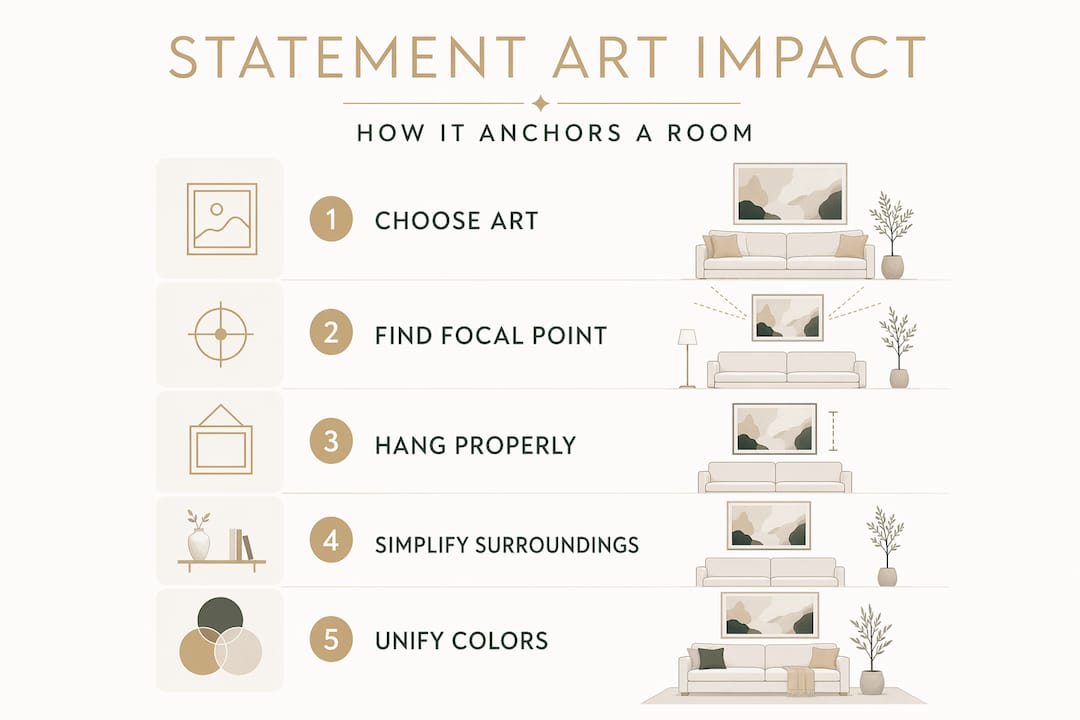
Think of statement art as a visual anchor. When you place a large, confident piece above a sofa or at the end of a hallway, the rest of the room begins to organize itself around it. Furniture feels placed with purpose. Colors feel connected. The room stops feeling like a collection of objects and starts feeling like a composed space.
How statement art transforms a room
The importance of statement art goes well beyond aesthetics. It does specific, practical work in a room that smaller or more generic decor simply cannot do.
Here’s how a single well-chosen piece changes a space:
- It adds character and personality. A room without statement art often feels like a hotel room. Clean, functional, forgettable. One bold piece that reflects your taste, your travels, or your sensibility makes the space unmistakably yours.
- It balances large or empty walls. A blank expanse of wall creates visual tension. Statement art balances empty walls by giving the eye somewhere to land and rest.
- It sets the mood of the room. A moody coastal photograph creates a different atmosphere than a bright abstract composition. The art you choose communicates the emotional register of the entire space before anyone sits down.
- It acts as a conversation starter. Guests ask about it. They remember it. A piece with a story, whether it’s a travel photograph, a commissioned work, or a found object, gives a room a social life.
- It makes a space feel designed. There’s a difference between a room that happened and a room that was considered. Statement art signals consideration. It tells visitors that someone made real choices here.
Pro Tip: Before buying, stand in the room and identify where your eye naturally goes first. That’s where your statement piece belongs. Don’t fight the room’s natural focal points. Work with them.
Large statement pieces also pull room colors together and can make ceilings feel taller by drawing the eye upward. These aren’t small effects. They reshape how a room feels to move through.
Types of statement wall art worth knowing
Understanding the types of statement art available opens up far more creative options than most people realize. The category is much wider than large oil paintings.
- Bold photography. A single oversized photograph, especially one with strong light, rich color, or a compelling subject, is one of the most accessible and powerful statement formats. Travel photography in particular carries a sense of story and place that abstract work sometimes doesn’t.
- Abstract and graphic compositions. Large abstract pieces work well in modern or minimalist spaces. They introduce color and energy without competing with architectural details or furniture.
- Three-dimensional wall sculpture. Wood carvings, metal loops, and stone panels add texture and dimensionality that flat art cannot. They change with the light throughout the day, which gives a room a living quality.
- Typography and text-based art. Big letters, neon lights, and painted wooden signs can be genuinely bold statement pieces when scaled and placed correctly. They express personality with directness.
- Unexpected and layered objects. Vintage maps, oversized mirrors with sculptural frames, woven fiber art, and mixed-media collages all qualify as unique wall art options when they’re large enough and intentional enough to anchor a space.
Here’s a quick comparison to help you match art type to room style:
| Art type | Best room style | Mood it creates |
|---|---|---|
| Bold photography | Coastal, eclectic, modern | Grounded, story-driven, warm |
| Abstract composition | Minimalist, contemporary | Energetic, open, sophisticated |
| 3D wall sculpture | Industrial, organic, bohemian | Textured, tactile, layered |
| Typography art | Casual, playful, modern farmhouse | Personal, direct, conversational |
| Mixed media or found objects | Eclectic, maximalist | Curated, collected, deeply personal |
The right type depends less on trend and more on what the room needs emotionally and visually. A bedroom that should feel like a quiet retreat calls for something different than a living room meant to spark conversation.
Design principles for placing statement art
Knowing what makes art a statement is one thing. Placing it well is another. These principles keep your piece from feeling lost or overwhelming.
Size and proportion
The most common mistake is choosing a piece that’s too small. As a general guideline, your art should span 60 to 75% of the width of the furniture beneath it or the wall section it occupies. A narrow print above a wide sofa looks like an afterthought. Scale up with confidence.
The 57-inch rule
Galleries and museums hang art with the center of the piece at approximately 57 inches from the floor. This eye-level centering creates visual harmony and prevents the piece from floating too high or sitting too low. In rooms with higher ceilings, you can move toward 60 inches, but the principle holds.
| Wall height | Recommended center height | Notes |
|---|---|---|
| Standard (8 ft) | 57 inches | Classic gallery standard |
| Taller (9–10 ft) | 58–60 inches | Slight upward shift for proportion |
| Very tall (11+ ft) | 60–65 inches | Avoid going too high; keep it relatable |
Simplifying the surroundings
In spaces with architectural texture, patterned wallpaper, or busy furniture, simplify everything else so the statement piece remains the quiet organizer of the room. Competing visual elements dilute the impact. Let the art breathe.
Pro Tip: If your room already has a lot going on texturally, choose a statement piece with a strong, simple composition. A single bold image with open negative space will hold its own far better than a complex, detailed piece that gets lost in the visual noise.
Statement wall decor ideas by room
Applying these ideas to specific rooms makes the concept concrete and easier to act on.
- Living room. The best statement wall art for living rooms typically lives above the sofa or on the wall facing the main seating area. A large canvas photograph or an oversized abstract piece works beautifully here. Choose something that reflects the emotional tone you want guests to feel when they walk in. Warm and grounded? Look for earthy tones and organic subjects. Energized and modern? Bold color and graphic abstraction.
- Bedroom. The wall above the headboard is prime statement territory. This is a personal space, so the art can be more intimate and reflective. A moody coastal photograph or a soft, luminous landscape creates the kind of calm you want to wake up to.
- Dining area. A single large piece on the wall opposite the table gives diners something to look at and talk about. Bold color works well here since the room is used in short, social bursts rather than long, quiet hours.
- Hallway or entryway. A statement piece at the end of a hallway creates a visual destination. It draws you through the space and sets the tone for the rest of the home.
When mixing a statement piece with a gallery wall nearby, keep the gallery wall on an adjacent or secondary wall. Let the statement piece have its own wall and its own moment. Crowding them together dilutes both.
My honest take on statement art
I’ve seen beautifully furnished rooms that felt completely empty. Not because they lacked furniture or color, but because nothing on the walls had any real weight. The art was there, technically. But it wasn’t saying anything.
What I’ve come to believe is that statement wall art is less about decorating and more about declaring. The piece you choose says something about what you value, where you’ve been, what moves you. When I’ve watched people find the right piece, something with genuine story and presence, the room doesn’t just look better. It feels inhabited in a way it didn’t before.
The mistake I see most often is playing it safe. People choose art that matches the sofa or fits the color palette perfectly, and the result is a room that feels coordinated but lifeless. A statement piece should have some tension with the room. It should feel slightly unexpected. That friction is what makes it memorable.
My other observation: people consistently underestimate size. The piece that looks enormous in the store will look exactly right on your wall. Go bigger than feels comfortable. You can almost always trust that instinct.
Statement art is where your home stops being a catalog page and starts being a memory map. Choose something that means something to you, place it with intention, and let it do its work.
— Info
Find your statement piece with Calicuration
Calicuration was built around exactly this idea: that the art on your walls should carry real story and feeling, not just fill space. Every piece in the collection comes from original, founder-shot travel photography, capturing California coastlines, desert light, city glow, and the quiet moments between. Each print is custom-produced on demand, so what arrives is made specifically for your space.
Whether you’re drawn to the warmth of a coastal sunset canvas or the clean tension of a minimalist architectural study, the collection holds a range of moods and scales designed to anchor a room with intention. Browse the full California wall art collection to find the piece that speaks to your space. And know that 5% of every order goes directly to community impact efforts in Los Angeles and New York City.
FAQ
What makes art a statement piece?
Statement wall art commands attention through scale, boldness, and emotional impact. It functions as a visual anchor for the room rather than a background element.
How big should statement wall art be?
Your piece should span roughly 60 to 75% of the width of the furniture or wall section beneath it. When in doubt, size up rather than down.
Can a photograph be statement wall art?
Absolutely. A large, bold photograph with strong composition and emotional resonance qualifies fully as statement art, especially when printed at scale on canvas or fine art paper.
What is the best placement for statement wall art in a living room?
The wall above the sofa or the wall facing the main seating area works best. Center the piece at approximately 57 to 60 inches from the floor for proper eye-level alignment.
Do statement art and gallery walls work together?
Yes. A statement piece and gallery wall complement each other well when placed on separate walls, letting each serve its distinct purpose without competing for attention.