

Table of Contents
- What Makes Travel Photography Prints Work in a Modern Home
-
Our Picks: Best Travel Photography Prints for Modern Homes
- 1. Coastal Landscapes: Calm, Open, and Endlessly Versatile
- 2. Urban and Architectural Photography: City Energy on Your Walls
- 3. Black and White Travel Prints: Timeless Over Trendy
- 4. Nature and Landscape Prints: Bringing the Outdoors In
- 5. Abstract and Conceptual Travel Art: For the Unconventional Wall
- Modern Coastal Wall Art: Choosing the Right Style for Your Space
- Black and White vs. Color: Which Photography Style Fits Your Interior
- Best Framing Styles for Photography Prints
- How to Arrange Travel Photos on a Wall
- Print Quality and Ethical Sourcing: What to Look For
- Conclusion
Last Updated: August 19, 2026
What Makes Travel Photography Prints Work in a Modern Home
Travel photography prints transform real moments from real places into permanent wall art that holds a mood, not just a location, but the feeling of being there, the quality of light, the sense that time paused for something worth remembering.
At CaliCuration, we've spent years thinking about exactly this. Every image in our collection was shot by our founder Peter during actual travel, never staged, never stock, never manipulated by AI. Modern homes benefit from travel photography because the aesthetic tends toward restraint. Clean lines, neutral palettes, and open space create a backdrop that lets a single strong image do real work. The right print anchors a room; the wrong one overwhelms.
The Psychology Behind Destination Art
Visual representations of travel environments reduce stress and promote mental spaciousness. The brain responds to landscape imagery similarly to actually being in that environment. A wide coastal horizon creates subtle expansion; urban photography stimulates and energizes. Choosing between them is a decision about how you want a room to feel.
Matching Print Mood to Room Atmosphere
The biggest mistake people make is picking an image they love in isolation, without considering the room it's entering. A moody beach print works beautifully in a bedroom but might feel heavy in a bright kitchen. Match the emotional temperature of the print to the room's function: calm, expansive imagery for rest spaces; energizing, graphic imagery for social and work spaces.
Our Picks: Best Travel Photography Prints for Modern Homes
Quick Picks:
- Best for Living Rooms: Coastal landscapes, open, versatile, mood-setting
- Best for Home Offices: Urban and architectural photography, energizing, graphic
- Best for Bedrooms: Moody or black and white prints, atmospheric, calming
- Best for Minimalist Spaces: Nature and landscape prints, clean, grounded
- Best Statement Wall: Abstract and conceptual travel art, unexpected, conversation-starting
1. Coastal Landscapes: Calm, Open, and Endlessly Versatile
Coastal landscape photography is the most universally successful style for modern homes. What separates fine art from generic beach decor is specificity of mood. Our California Central Coast Sunset Canvas captures a particular quality of late afternoon Pacific light that feels warm, unhurried, and genuinely West Coast. The Harvest Moon Beach Framed Canvas offers moonlit shoreline with cinematic depth, ideal for bedrooms where atmosphere matters more than brightness.

For versatility across minimalist, coastal, bohemian, and Scandinavian interiors, a large-format coastal canvas is the safest starting point and often the most impactful single piece you can add.
2. Urban and Architectural Photography: City Energy on Your Walls
Home offices, studios, and hallways benefit from visual tension and energy. Our Manhattan Bridge and East River Framed Poster demonstrates this through steel, water, and iconic geometry creating both art and architecture. The NYC Street Signs Framed Poster turns the city's visual language into bold, character-driven wall art that works especially well in industrial and minimalist interiors.
Urban prints also anchor gallery wall arrangements, where their strong lines complement looser, organic landscape photography.
3. Black and White Travel Prints: Timeless Over Trendy
Monochrome prints strip away color distraction and let composition, light, and texture carry the work. The result is wall art that ages with a space rather than dating it. Our Cotswolds Summer Black and White Framed Poster reveals the English countryside's timeless quality through light, texture, and quiet character.
Black and white travel prints work particularly well in minimalist and modern farmhouse interiors, and in gallery walls where they provide visual rest between vibrant pieces.
4. Nature and Landscape Prints: Bringing the Outdoors In
Landscape photography creates spatial expansion, making rooms feel larger and more open, especially valuable in smaller spaces or rooms without much natural light. Choose landscapes with genuine depth: foreground, mid-ground, and distance. Our Malibu Canyon Wildflowers Framed Poster draws the eye through layers of seasonal wildflowers and open sky. The Majestic Tree by a European Lake Aluminum Print pairs still water with a powerful focal point; the aluminum medium adds clarity and subtle luminosity.
5. Abstract and Conceptual Travel Art: For the Unconventional Wall
Abstract and conceptual travel photography references a real place but prioritizes visual impact over literal representation. Our Airplane Turbine Aluminum Print turns a transatlantic flight into something sculptural, above the Atlantic, framed by open sky, it captures the feeling of being between destinations in a way no postcard could.
This type of print works best as a standalone statement piece or as an anchor in a gallery wall mixing travel photography styles.
Modern Coastal Wall Art: Choosing the Right Style for Your Space
Modern coastal wall art differs from traditional beach decor through mood and specificity. Traditional coastal tends toward bright, saturated blues and sandy tones. Modern coastal is more restrained: muted palettes, atmospheric light, and compositions that suggest rather than announce. Generic seascapes read as decoration; photographs of specific coastlines with particular light, color, and character read as art. For modern homes, lean toward warm-toned sunset or golden-hour coastal photography for living rooms and dining areas; moody, atmospheric coastal prints for bedrooms; clean, high-contrast coastal photography for home offices.
The Mediterranean Sunset Framed Poster offers rich, warm, atmospheric tones without garishness. The Moody Venice Beach Canvas delivers cinematic quality perfect for spaces designed for rest and atmosphere.


Black and White vs. Color: Which Photography Style Fits Your Interior
Choose color photography when:
- The room has a neutral palette that needs warmth or visual interest
- The print functions as the room's color anchor
- Colors complement existing furnishings
- Emotional impact depends on the palette
Choose black and white photography when:
- The room already has strong color and needs visual balance
- You want a print that works across multiple interior changes
- Composition is strong enough to carry the image without color
- You're building a gallery wall and need cohesion across subjects
For most modern homes: one of each, in different rooms, chosen for function rather than consistency.
Best Framing Styles for Photography Prints
The frame changes how a photograph reads in a space as much as the image itself.
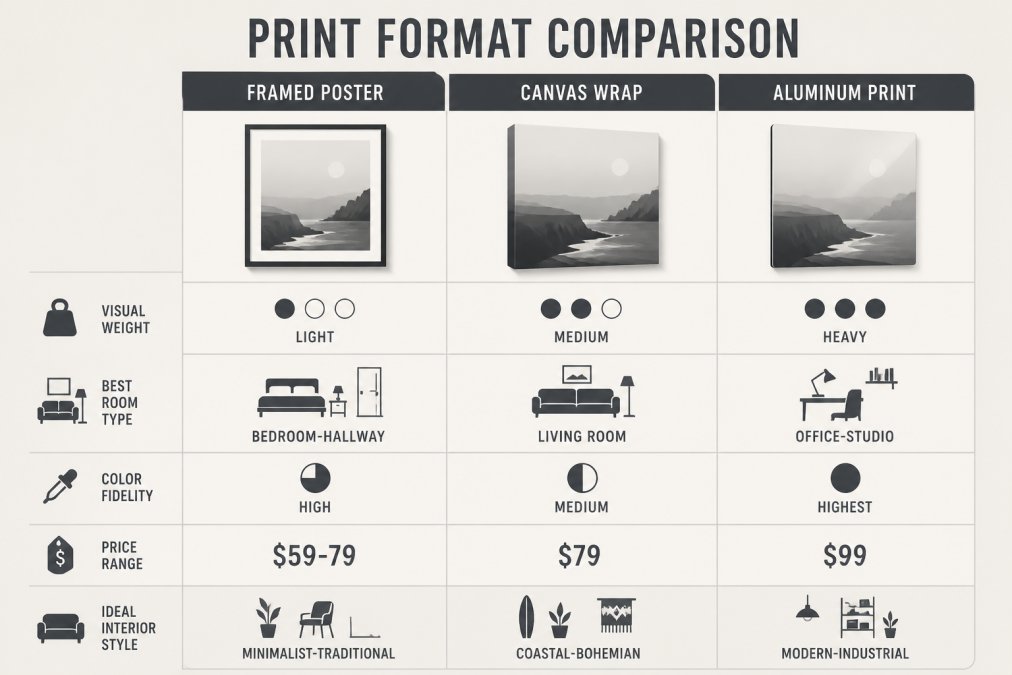
Framed Posters vs. Canvas Wraps vs. Aluminum Prints
Framed posters are the most versatile option. A wooden frame, particularly ash or pine, adds warmth and a finished, gallery-ready quality. The frame creates a visual boundary that helps the print hold its own on a busy wall.
Canvas wraps sit between framed posters and aluminum prints in visual weight. The wrapped edge feels slightly more casual, working well in coastal, bohemian, and contemporary interiors. Giclée printing on canvas produces rich, accurate color that holds up over time with archival inks.
Aluminum prints are the most contemporary option and best for modern and industrial interiors. The surface adds subtle luminosity and sharpness that no other medium matches. They work especially well for architectural photography, abstract travel art, and any image where clarity is part of the visual impact.
All CaliCuration prints are ready to hang, with mounting included.
Sizing and Scale: Getting It Right for Your Wall
Scale is where most people make their first mistake. The instinct is to buy smaller than the wall needs, and the result is a print that floats without purpose. A practical guide: for a single focal point, the print should cover roughly two-thirds of the wall width. Tall, vertical prints suit narrow walls and stairwells. Wide, horizontal prints suit space above sofas, beds, and dining tables. Square prints are most flexible and work well in grid arrangements.
Wall Width |
Recommended Print Width |
|---|---|
Under 36 inches |
12-18 inches |
36-60 inches |
20-30 inches |
60-90 inches |
30-40 inches |
Over 90 inches |
40+ inches or gallery wall |
How to Arrange Travel Photos on a Wall
Gallery wall arrangement intimidates people most, but it's also most forgiving once you understand the underlying logic.
Building a Cohesive Travel-Themed Gallery Wall
A cohesive travel-themed gallery wall doesn't require every print from the same destination. It requires visual consistency across a few key variables.
Step 1: Choose a unifying element. This could be a consistent color palette (all warm-toned or all monochrome), a consistent frame style (all wood or all frameless), or a consistent subject type (all landscape or mixed).
Step 2: Select an anchor piece. Every successful gallery wall has one larger or more visually dominant piece. A large-format coastal canvas or bold architectural print works well in this role.
Step 3: Plan before you hang. Lay the prints on the floor in your intended arrangement. Live with it for a day before committing to holes in the wall.
Step 4: Start from the center and work outward. Hang the anchor piece first, at eye level (roughly 57-60 inches from floor to center). Build the arrangement outward, maintaining consistent spacing between frames, typically 2-3 inches for a tight, gallery-style look, or 4-6 inches for a more relaxed arrangement.
Step 5: Mix orientations and sizes deliberately. A gallery wall with all the same-sized frames in the same orientation reads as flat. Varying between portrait and landscape orientations creates visual rhythm.
Lighting Your Wall Art for Maximum Impact
Lighting changes how a print reads more dramatically than any other element. Natural light is ideal but inconsistent; direct sunlight fades prints over time. Position prints where they receive indirect natural light.
For artificial lighting, picture lights and adjustable track lighting are most effective. The recommended lighting angle for wall art is 30 degrees from vertical, which minimizes glare while providing even illumination. Warm-white bulbs (around 2700-3000K color temperature) complement warm-toned photography particularly well.
Print Quality and Ethical Sourcing: What to Look For
The question we hear most often from disappointed buyers is: "Why does it look so different in person?" The answer is almost always one of three things: low-resolution source files, poor print medium, or color-uncalibrated output.
Resolution and file quality determine how a print holds up at larger sizes. All CaliCuration photographs are original, high-resolution files shot by Peter on professional equipment, printing cleanly at every size in our range.
Print medium affects color accuracy and longevity. Archival quality inks on museum-quality matte paper or giclée printing on canvas hold color accurately for decades under normal conditions.
Color calibration is the technical step most budget providers skip. Without it, screen colors don't match printed output. Responsible studios calibrate output against standardized color profiles, a step that costs more but produces prints that match what you ordered.
We partner with print-on-demand studios using eco-friendly materials and packaging, produced locally where possible. Prints are made to order rather than held in inventory, eliminating overproduction waste entirely. And 5% of every order funds community impact efforts, built into our business model, not added as an afterthought.
A well-produced print on quality materials will outlast and outperform a cheap print at any size.
Print Style |
Best Room |
Frame/Medium |
Mood |
|---|---|---|---|
Coastal Landscape |
Living room, bedroom |
Canvas or framed poster |
Calm, expansive |
Urban / Architectural |
Home office, hallway |
Framed poster |
Energizing, graphic |
Black and White |
Bedroom, any room |
Framed poster (wood) |
Timeless, refined |
Nature / Landscape |
Any room, small spaces |
Framed poster or aluminum |
Grounded, restorative |
Abstract / Conceptual |
Statement wall, office |
Aluminum print |
Bold, conversation-starting |
The right travel photography print transforms a room by bringing genuine atmosphere and specificity into your space. Whether you're drawn to coastal calm, urban energy, or timeless monochrome, the key is choosing work that reflects both the place it came from and the feeling you want to create at home. Explore our collection to find the pieces that speak to your space.
Frequently Asked Questions
How do you style travel photography in a modern home?
Start with one anchor print sized to the wall — typically 24x36 inches above a sofa or console. Build outward from there using prints that share either a color palette or a subject theme, like coastlines or cityscapes. Keep frames consistent in finish if not in size. Warm ambient lighting positioned above or beside the art brings out depth in fine art photography and makes the whole arrangement feel intentional rather than random.
Should travel photography be framed or printed on canvas?
Both work well, but the choice depends on your interior. Framed posters suit minimalist and contemporary spaces where clean lines matter — the frame adds structure and visual weight. Canvas wraps feel softer and work naturally in coastal or bohemian rooms. Aluminum prints are the sharpest option for modern or industrial interiors, offering vivid color and a gallery-quality finish with no frame needed. Consider the room's existing textures before deciding.
What size wall art works best above a sofa?
A single print should span roughly two-thirds the width of the sofa beneath it — so a 90-inch sofa pairs well with art around 60 inches wide. For a gallery wall arrangement, the overall grouping should hit that same two-thirds proportion. Hang the center of the piece or grouping approximately 57 to 60 inches from the floor, which places the visual midpoint at eye level. Going too small is the most common mistake — it makes the art look lost.
How do I choose travel prints that match my interior design style?
Match the mood of the image to the mood of the room. Moody, atmospheric coastal photography works in spaces with dark walls or tactile textiles. Bright, color-saturated landscape photography lifts neutral or white-walled rooms. Monochrome architectural prints suit minimalist or industrial interiors. Look at your existing color palette and choose prints whose dominant tones appear somewhere in your furnishings — that connection is what makes art feel chosen rather than placed.
What is modern coastal wall art?
Modern coastal wall art uses photography or illustration of shorelines, seascapes, and beach landscapes styled for contemporary interiors rather than traditional nautical decor. It favors clean compositions, muted or warm tones, and high-resolution imagery over the shell-and-rope aesthetic. Pieces like moody beach canvases or sunset coastal photography bring the feeling of the ocean into a space without leaning into clichéd seaside motifs — making them versatile across minimalist, Scandinavian, and bohemian interiors alike.