

Travel photography turns rooms into lived stories. One well-chosen image can anchor mood, memory, and meaning in a way that mass-produced art simply cannot. The reason is rooted in three things: autobiographical memory (your brain recognizes the place and the feeling simultaneously), authentic light and color that integrate naturally with real interiors, and the singular quality of a photograph you actually took. No two people own the same moment.
- Personal memory anchor: A photo from the Amalfi coast or a quiet Kyoto alley carries your specific story, not a stock image’s generic mood.
- Authentic light and tone: Travel shots capture real-world light, which tends to harmonize with furniture and textiles more easily than manufactured art.
- Singularity: Your image exists nowhere else on anyone else’s wall.
Quick takeaway: Pick one image that genuinely moves you, print it well on an archival surface, and hang it where you spend the most time. That single step changes how a room feels.
Table of Contents
- Why travel photos change how a room feels
- Which travel photos work best for your walls
- Hanging ideas and layouts that make travel photos feel intentional
- Materials and print choices that make travel photos read like art
- How to coordinate travel photos with your room’s color and scale
- Curating a travel-photo story across your home
- How Calicuration brings travel photography into curated decor
- Key Takeaways
- Why this matters more than most decorating advice admits
- Calicuration travel prints, ready for your walls
- Useful sources and further reading
Why travel photos change how a room feels
The effect goes deeper than aesthetics. Travel photos anchor living spaces in personal history, turning generic rooms into identity-driven narratives. Environmental psychology research consistently shows that natural landscape imagery lowers perceived stress, while complex, layered scenes, a market alley, a cathedral facade, a coastal cliff, keep the mind gently engaged without overstimulating it.
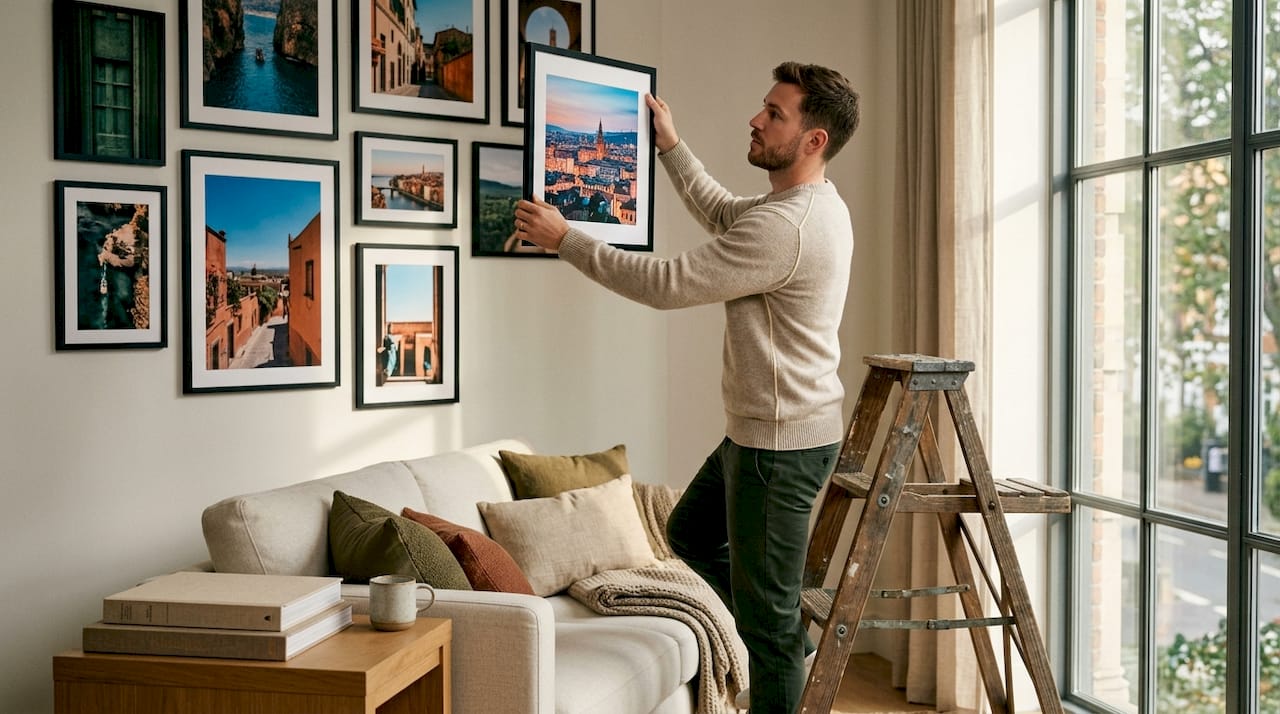
There is also a design mechanic at work. Travel photography captures real-world light: the golden hour warmth of a desert road, the cool blue of a Nordic harbor, the dappled shade of a Tuscan olive grove. Those tones already exist in nature, which means they sit comfortably alongside wood, linen, stone, and painted walls without forcing a color match. Photography makes meaningful decor precisely because it carries emotional weight that purely decorative art rarely achieves.
Key reasons the impact of travel photos on decor runs so deep:
- Identity reinforcement: Surrounding yourself with images of places you have been reflects who you are, not who a trend magazine says you should be.
- Mood calibration: Soft coastal shots calm a bedroom; dramatic mountain ridgelines energize a home office.
- Conversation and connection: A striking travel image invites guests into your story in a way a generic print never does.
- Place-evocation: The right photograph can make a room feel like it belongs somewhere specific, somewhere you love.
Which travel photos work best for your walls
Not every travel photo belongs on a wall, and that distinction matters. Successful travel-inspired decor relies on intentional selections that reflect personal experience rather than trend-chasing or souvenir clutter.
Motifs that scale well:
- Wide landscapes and seascapes with strong horizon lines
- Architectural studies: doorways, arches, staircases, facades
- Quiet street scenes with natural depth and leading lines
- Close-up textures: weathered stone, woven fabric, salt-bleached wood
Subjects to avoid for wall display:
- Crowded snapshots where faces compete for attention
- Selfies and group photos (better suited to albums and private spaces)
- Low-resolution phone images that lose detail when printed large
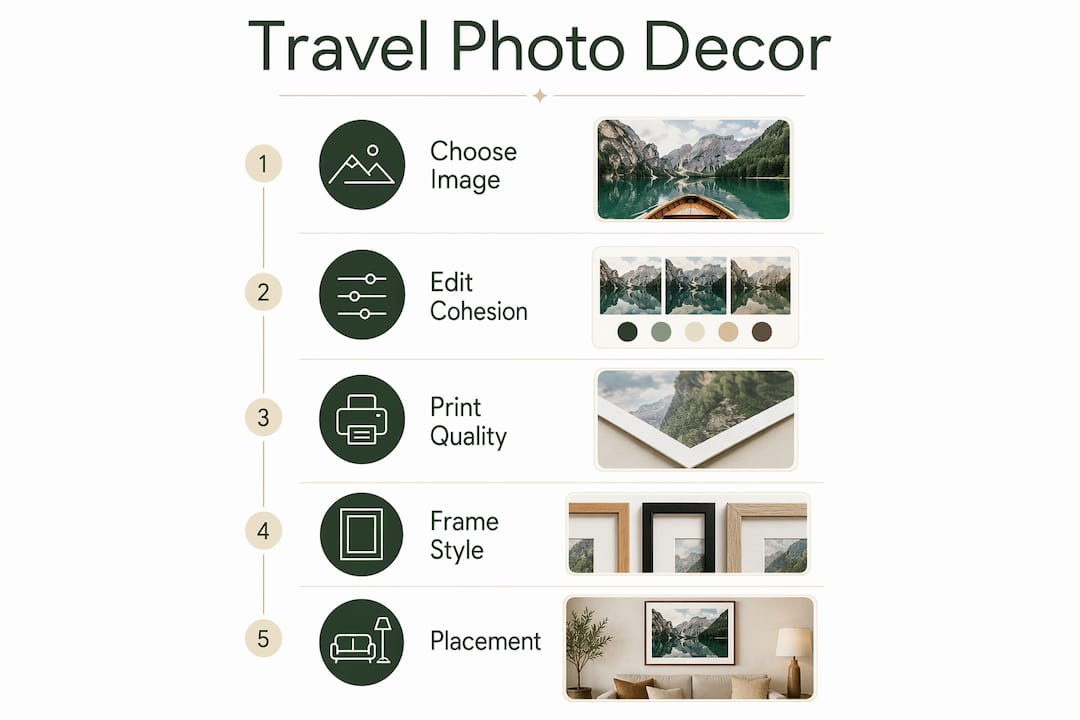
Editing for cohesion: If you are mixing images from different trips, run them through a consistent Lightroom preset or apply a shared tonal adjustment, warm shadows, slightly desaturated highlights, for example. A curated rule-of-three approach to sizing and simple color editing can make disparate images feel like a considered collection rather than a random assortment.
Pro Tip: Before you print anything, live with the image on your phone lock screen for a week. If you still love it after seven days of seeing it every morning, it belongs on your wall.
Hanging ideas and layouts that make travel photos feel intentional
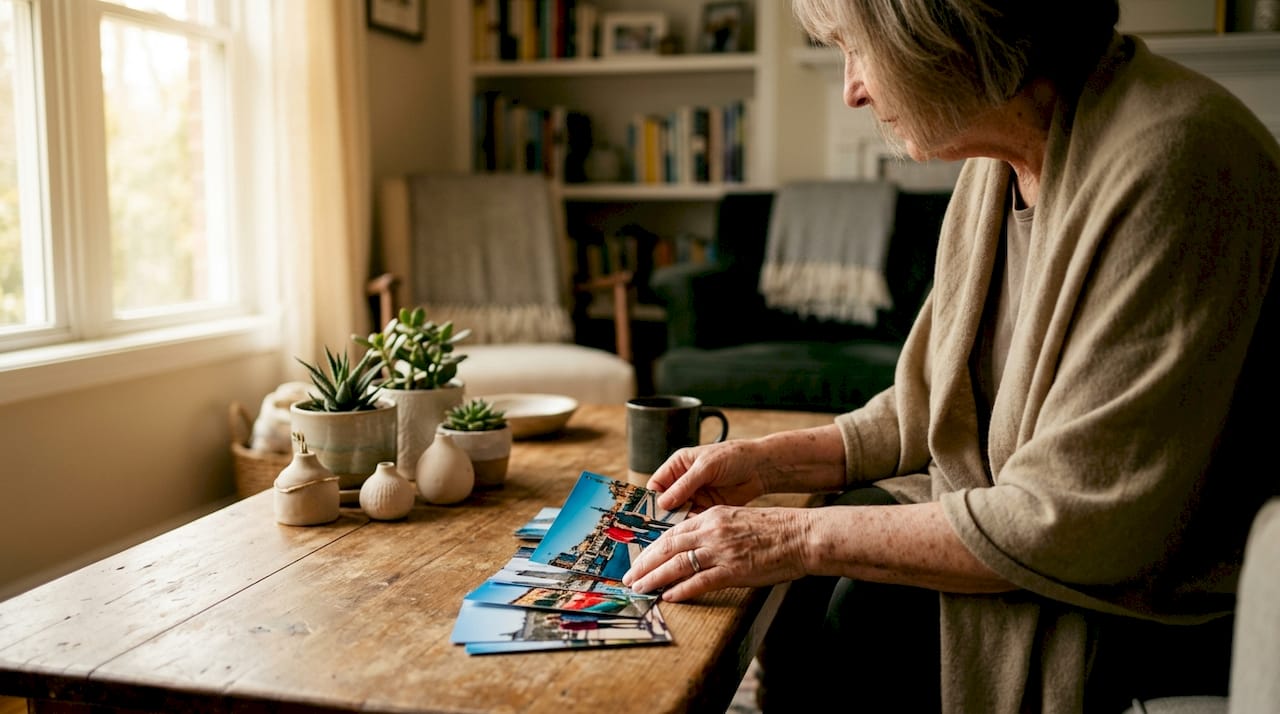
How you hang matters as much as what you hang. Printing travel photos helps them feel settled in a room; images that stay on phones never fully become part of daily life. Here are the main display options and when each works best:
- Single statement piece: One large print (24×36 inches or bigger) above a sofa or bed. Clean, confident, and the easiest way to avoid clutter.
- Triptych or diptych: Two or three related images in matching frames, hung with equal gaps. Works beautifully with a series from one trip or one subject.
- Gallery wall: A curated mix of sizes and orientations. Mixing scales and orientations makes a gallery feel organic and allows the collection to grow without looking forced.
- Linear hallway run: A single row of same-height frames along a corridor, spaced evenly, creates a quiet editorial rhythm.
- Shelf ledge mix: Lean smaller prints against a shelf wall alongside books and objects for a relaxed, layered feel.
Practical placement checklist:
- Hang the center of any piece at eye level, roughly 57–60 inches from the floor.
- Leave at least 6–8 inches between the top of furniture and the bottom of a frame.
- Keep gaps between gallery wall frames consistent: 2–3 inches reads intentional; more than 4 inches starts to feel scattered.
- Use intentional negative space between pieces so each photograph retains its own presence.
- Check the lighting before you commit: picture lights or adjusted ambient bulbs can dramatically improve how a print reads on the wall.
For a classic combination, try one large landscape (24×30) flanked by two smaller verticals (8×10 or 11×14), all sharing a tonal family. The asymmetry feels collected rather than matched. Explore more display ideas and layouts for practical room-by-room guidance.
Materials and print choices that make travel photos read like art
Surface matters enormously. The same image printed on matte fine-art paper, stretched canvas, and brushed aluminum reads as three entirely different objects in a room.
| Surface | Visual quality | Glare | Durability | Best rooms |
|---|---|---|---|---|
| Canvas | Warm, painterly, soft detail | None | High | Bedroom, living room |
| Framed fine-art paper | Crisp detail, rich tones | Low (with matte glass) | High with UV glass | Any room |
| Aluminum/metal | Vivid, luminous, high contrast | Moderate | Very high | Kitchen, bathroom, modern spaces |
| Acrylic face-mount | Deep color, gallery-grade depth | High | High | Statement walls, contemporary interiors |
Canvas prints soften detail and reduce glare, making them a favored choice for rendering travel photos as warmer, more artful pieces in living spaces. For archival longevity, look for pigment-based inks (not dye-based), museum-grade papers rated for 75+ years, and UV-protective coatings or glass. A coastal canvas in a bedroom, for instance, brings the salt-air calm of a shoreline into the space without competing with soft furnishings.
High-quality mediums let travel photography function as a true design element rather than an afterthought. Browse wall art by material to compare canvas, framed, and aluminum options side by side.
How to coordinate travel photos with your room’s color and scale
Travel photography works naturally in minimalist interiors because its authentic tones sit comfortably alongside furniture and textiles without forced color-matching. That said, a little intentionality goes a long way.
Color coordination tips:
- Use your room’s existing palette as a starting point. If your walls are warm cream and your sofa is forest green, look for images with amber light or deep foliage tones.
- Edit photos to a shared warmth or coolness before printing. A minimalist home with color often benefits from one or two travel images that introduce a single accent hue rather than competing palettes.
- Avoid forcing exact matches. A photograph that shares the mood of a room is more harmonious than one that matches a cushion color precisely.
Scale rules:
- Statement pieces should span at least half the width of the furniture they hang above.
- Small prints (5×7 to 8×10) belong on shelves, in nooks, or as supporting pieces in a gallery wall, not as solo focal points on large walls.
- Negative space prevents a scrapbook look. Give each piece room to breathe.
Pro Tip: Pull one color accent from your favorite travel image, a terracotta, a dusty sage, a warm sand, and echo it in a throw pillow, a ceramic vase, or a woven tray nearby. The room will feel like it was always meant to hold that photograph.
Curating a travel-photo story across your home
A single great print is a statement. A thoughtfully placed collection across multiple rooms becomes something closer to a memory map. A travel-photo program that places images throughout private and public rooms creates a consistent personal narrative rather than a single theme wall for guests.
Editorial guidelines:
- Choose two or three recurring motifs (coastlines, architecture, open roads) and let them thread through the home.
- Vary orientation and subject so the collection feels alive, not matchy.
- Allow scale to shift: a large canvas in the living room, medium framed prints in the hallway, small ledge pieces in the bedroom.
Room-by-room approach:
- Living room: Your most public space. Choose images with broad emotional resonance, a wide landscape, a dramatic cityscape, something that invites conversation.
- Bedroom: More personal. Soft coastal shots, misty forests, or quiet architectural details work well here. This is where intimate travel memories belong.
- Hallway: A linear sequence of images from one trip or one subject creates a quiet narrative as you move through the home.
- Home office: Images with energy and depth, mountain ridgelines, geometric architecture, can support focus and creative thinking.
Building the collection over time:
- Start with one or two pieces and add deliberately, not all at once.
- Repeat a tonal accent or a frame style to tie new additions to existing pieces.
- Curating your home interior with travel memories works best as an evolving practice. Let the collection grow as you do.
Market trends show a clear move away from bulky gallery walls toward intentional groupings with breathing room. Quality over quantity is what makes travel decor feel sophisticated rather than cluttered.
How Calicuration brings travel photography into curated decor
We started Calicuration during the pandemic in Los Angeles, when the desire to bring the outside world indoors felt more urgent than ever. Every photograph in our collection is founder-shot, meaning each image carries a real story from a real place, whether that is the golden light of a California desert road, the cool geometry of a coastal cliff, or the quiet drama of a city at dusk.
Our production values reflect that commitment:
- Museum-grade materials: Pigment inks, archival canvas, and UV-protective finishes built to last decades.
- Custom sizing and on-demand production: Every piece is made to order, so nothing sits in a warehouse and every print is fresh.
- Curated collections: From California coast to black-and-white architectural studies, each collection is edited with a consistent tonal story in mind.
- Giving back: 5% of every order supports community impact efforts in Los Angeles and New York City.
For a bedroom that needs the calm of salt air and open water, our coastal canvas wall art is a natural starting point. For a more graphic, architectural mood, the Architectural Light Study canvas brings quiet drama to a living room or home office.
Pro Tip: If you are unsure where to start, choose one room, identify its dominant mood (calm, energized, warm, cool), and match a single Calicuration print to that feeling. One piece, placed well, changes everything.
Key Takeaways
Travel photography enriches home decor because it combines autobiographical memory, authentic light, and singular storytelling in a way no mass-produced art can replicate.
| Point | Details |
|---|---|
| Choose images you can live with | Test an image on your phone lock screen for a week before printing it large. |
| Match material to the room | Canvas for bedrooms and living rooms; metal or acrylic for kitchens and contemporary spaces. |
| Hang with breathing room | Use intentional negative space between pieces so each photograph retains its own presence. |
| Build a tonal story | Edit images to a shared warmth or coolness so mixed-trip photos feel like a cohesive collection. |
| Calicuration for curated prints | Founder-shot, archival-quality travel photography produced on demand, with 5% of every sale supporting community impact. |
Why this matters more than most decorating advice admits
There is a tendency in interior design content to treat wall art as the last step, the thing you do after the sofa is chosen and the rug is laid. We think that gets it exactly backward. The photographs you choose to live with every day are among the most revealing things about a home. They tell visitors, and more importantly they remind you, where you have been, what moved you, and what kind of life you are building.
Photography beats souvenirs for one simple reason: a well-printed image gives you the feeling of a place without the clutter of an object. It asks nothing of the room except a wall and good light. And unlike a trinket that fades into the background, a photograph you genuinely love keeps working on you quietly, every morning, every evening, every time you walk past it.
Start small. One image, printed well, hung at eye level with room to breathe. That is enough to begin.
Calicuration travel prints, ready for your walls
If the ideas in this article have you thinking about which image belongs above your sofa or beside your bed, our collections are a good place to look. Calicuration’s canvas wall art brings founder-shot travel photography into your home on archival surfaces, warm and low-glare, sized to your wall. For something more graphic and contemporary, the abstract and travel-influenced prints collection offers place-evocative pieces that work in modern and minimalist interiors alike.
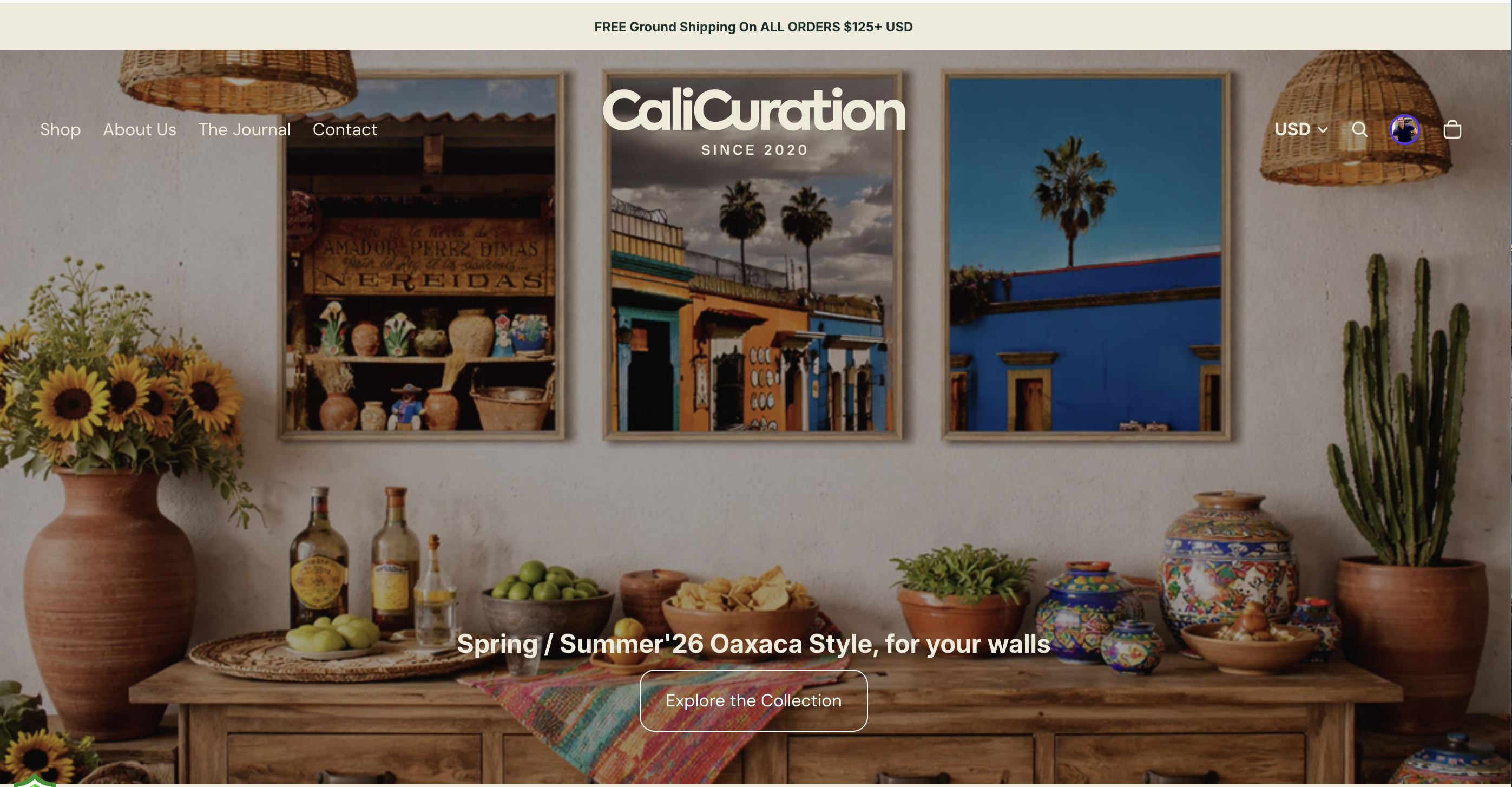
Every piece is produced on demand, custom to your size, and ships with the knowledge that 5% of your order goes directly to community impact work in Los Angeles and New York City. Browse the full wall art collection and find the image that already feels like yours.
Useful sources and further reading
- Luxury Wall Art: How Travel Photography Transforms Modern Interiors — Covers autobiographical memory, design mechanics, and the case for intentional curation over trend-driven choices.
- Using Canvas Prints to Turn Travel Memories into Home Decor — Practical guidance on canvas as a surface choice and how authentic tones integrate with minimalist interiors.
- Creating a Travel-Inspired Home Using Your Own Photography — Covers printing, negative space, and mixing scales and orientations for a gallery that feels organic.
- Travel-Inspired Home Decor: Bringing Wanderlust Vibes into Your Living Space — Addresses sizing strategies, intentional groupings, and the trend toward quality over quantity in travel decor.
- The Art of Travel Photography in Home Decor, House of Coco Magazine — Explores the cultural and emotional dimensions of travel photography as storytelling within the home.
- Wall Art Inspiration and Decorating Ideas, Calicuration — A curated starting point for readers who want to see how travel photography translates into real room settings before they buy.