

California-inspired design is one of those phrases that gets tossed around loosely, often reduced to driftwood shelves and linen throw pillows. But what is California-inspired design at its core? More precisely, it belongs to a broader tradition that designers call California Casual or California Modern, a lifestyle-driven philosophy shaped by climate, craft, and a deep resistance to European formality. It is warm without being rustic, refined without feeling cold. This guide unpacks where the style comes from, what it actually looks like, and how you can bring it into your home with intention.
Table of Contents
- Key Takeaways
- What is California-inspired design rooted in?
- Core elements of the California aesthetic
- Modern interpretations of the style
- How to achieve California style in your home
- Our perspective on this enduring style
- Bring California light into your walls
- FAQ
Key Takeaways
| Point | Details |
|---|---|
| More than beach decor | California-inspired design is a lifestyle philosophy rooted in materiality, light, and regional craft, not coastal themes. |
| Natural materials define the look | White oak, linen, stone, and woven textures create the tactile warmth central to the style. |
| Indoor-outdoor flow is foundational | Sliding glass doors, open layouts, and seamless material transitions are structural, not decorative, choices. |
| Curation beats accumulation | Mixing vintage pieces with modern furniture creates spaces that feel collected and personal, not staged. |
| Wit keeps it alive | Adding one unexpected element prevents a neutral California interior from feeling flat or overly polished. |
What is California-inspired design rooted in?
To understand this aesthetic, you have to go back to the land itself. California decorative arts are inseparable from climate, landscape, migration, and Indigenous knowledge, forming a deeply rooted regional design language that no other American style can fully replicate.
Several distinct cultural threads wove together to create what we now recognize as the California aesthetic:
- Indigenous craft traditions that valued natural materials, handwork, and functional beauty
- Spanish Colonial and Mediterranean influences that introduced courtyard living, clay tile, and thick plaster walls
- The Arts and Crafts movement of the early 20th century, which championed honest materials and visible joinery over ornament
- Mid-century modernism, which brought clean geometry, open floor plans, and glass walls that dissolved the boundary between inside and out
The climate did as much as any architect. Mild winters and abundant sun made indoor-outdoor living not a design choice but a practical reality. Rooms opened onto gardens. Kitchens spilled onto patios. The light itself became a material.
“The California Look’s major contribution is making high-end design accessible and genuinely livable, breaking from European formality.” — California Decorative Arts
This rejection of formality is what separates the style from its peers. California style rejects elite European formality, proving that sophisticated homes can prioritize informal, family-friendly comfort. Children, open shelving, handmade objects, and casual meals at a long wooden table are all part of the picture.
Core elements of the California aesthetic
Once you know the philosophy, the visual language makes complete sense. California-inspired design is more of a lifestyle-driven philosophy than a fixed checklist, but certain materials, colors, and spatial principles appear consistently across authentic examples.
Color palette. The tones mirror the landscape directly. Whites that read warm rather than stark. Sand, stone, greige, and the occasional dusty terracotta. Warm neutral palettes reflecting the regional landscape form the foundation, with bold synthetic colors avoided in favor of earthy tones.
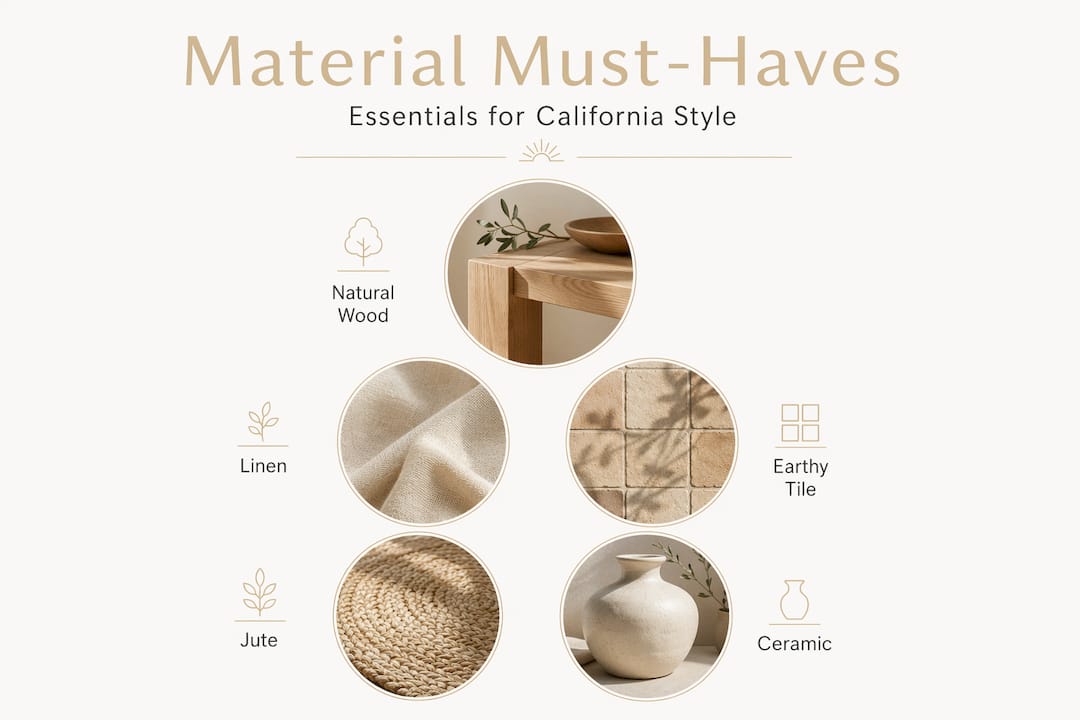
Materials. This is where the style earns its depth. Expect:
- White oak flooring with visible grain
- Natural stone on countertops and floors
- Unlacquered brass hardware that ages naturally
- Linen, cotton, and woven jute on upholstery and textiles
- Organic ceramics and rattan accents
Material authenticity — showing wood grain, valuing warm clay, vibrant tile, and soft textiles — is central to the tactile experience of the style.
Spatial principles. Natural light is treated as a design element, not an afterthought. Open layouts allow air and light to move freely. Indoor-outdoor connection is foundational, often using sliding glass doors, patios, and seamless material transitions that blur living space boundaries and effectively double usable space.
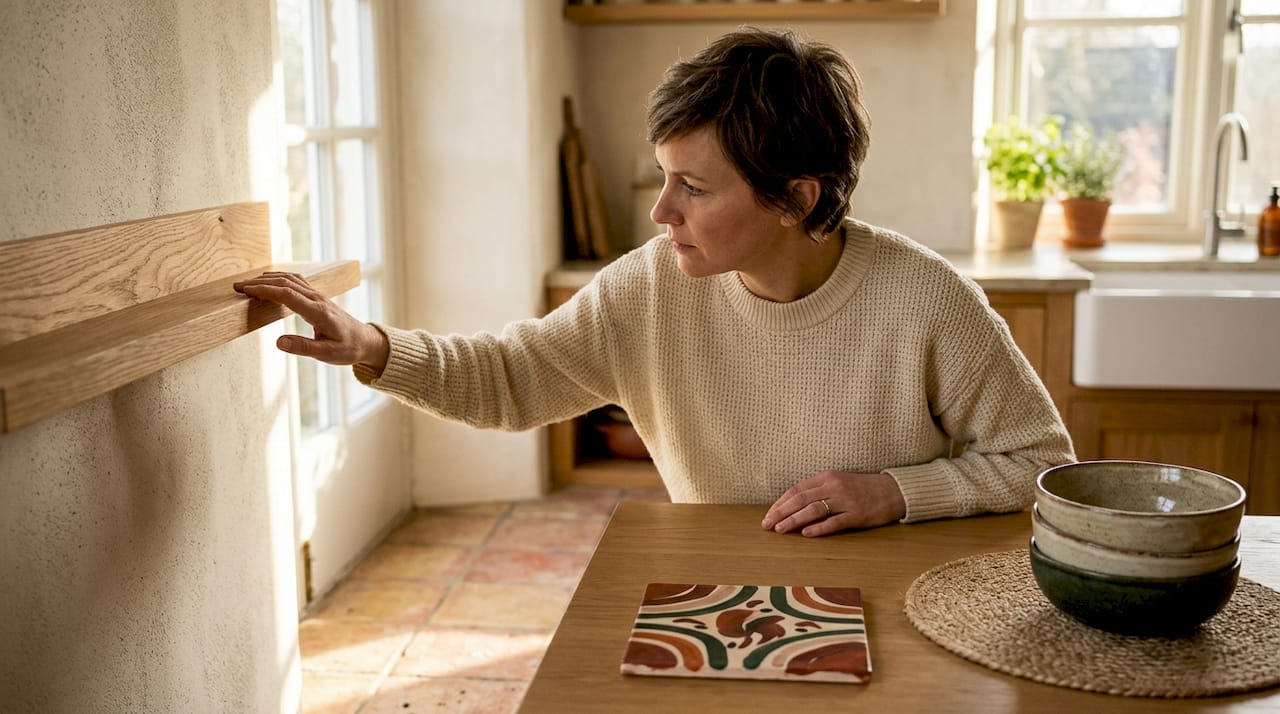
Furniture. Pieces sit low and feel generous. A wide linen sofa, a chunky coffee table in live-edge wood, a rattan chair that invites you to stay longer. Nothing is precious or untouchable.
Pro Tip: Avoid the temptation to add coastal motifs like anchors, shells, or nautical stripes. Authentic California-inspired home decor draws from the land and the light, not the shoreline gift shop.
Modern interpretations of the style
The California aesthetic is not frozen in a single decade. Contemporary designers interpret it in two loosely defined directions, and understanding both helps you make intentional choices for your own space.
-
California Casual leans into warmth, texture, and a relaxed sophistication. Typical materials include white oak, linen, cotton, stone, jute, rattan, and organic ceramics. The mood is unhurried and tactile, like a well-loved home that grew over time.
-
California Modern brings mid-century geometry and cleaner lines into conversation with those same warm materials. It blends mid-century minimalism with warmer coastal textures, prioritizing livability and progression over preservation. A Palm Springs renovation might keep the original butterfly roof while swapping out dated interiors for current furniture with strong silhouettes.
-
The curated mix is where both approaches converge. Designers often source wood salvaged within 30 minutes of the site to create breathable, comfortable spaces emphasizing quality over ornamentation. Vintage pieces sit alongside modern ones. A 1960s ceramic lamp on a contemporary side table. An old kilim rug under a clean-lined sofa.
-
The unexpected detail. Expert Tamara Honey highlights that including a little wit or surprise prevents California-inspired interiors from feeling boring or overly polished. One piece that makes you pause, a sculptural object, an unusual textile, a piece of art that tells a story, keeps the whole room alive.
How to achieve California style in your home
Bringing this aesthetic into your space does not require a full renovation. It requires thoughtful editing and a willingness to choose quality over quantity.
Start with your palette. Layer your neutrals rather than picking one and repeating it. A warm white wall, a sand-colored linen sofa, a stone gray rug, and a honey-toned wood floor create depth without visual noise.
Choose materials with intention. Touch matters in this style. Swap synthetic textiles for natural ones. Add a woven tray, a clay vase, a linen cushion. Each texture adds to the sensory warmth of the room.
Open up the space. If you have a door or window that connects to an outdoor area, make that transition as seamless as possible. Use the same flooring material inside and out where you can. Keep the sightline clear.
| What works | What to avoid |
|---|---|
| Warm white walls with layered neutrals | Bright white walls with no warmth |
| Natural wood with visible grain | High-gloss lacquered furniture |
| Linen, jute, and organic cotton textiles | Synthetic fabrics in bold patterns |
| A few meaningful objects and art pieces | Cluttered shelves with themed decor |
| One unexpected or personal accent piece | Overly matched, catalog-ready styling |
Pro Tip: When styling shelves or surfaces, follow the rule of three textures: one rough, one smooth, one woven. This creates the layered, collected feeling that defines authentic California interiors without tipping into clutter.
You can also find eclectic living room ideas that show how unexpected accent pieces add personality to a neutral base, which is exactly the spirit of this style.
Our perspective on this enduring style
I’ve spent a lot of time thinking about why California-inspired design keeps resonating, even for people who have never set foot in the state. My honest take is that it speaks to something most of us are quietly craving: a home that feels like it was lived in before you arrived, collected rather than assembled.
What I’ve noticed is that the biggest mistake people make is treating this style like a mood board to replicate. They source all the right materials and still end up with a room that feels flat. The missing ingredient is almost always personal meaning. A piece of art that came from a trip you remember. A ceramic bowl from a maker whose work you genuinely love. That specificity is what transforms a California-inspired space from a style exercise into something that actually feels like yours.
The style’s core values, honesty in materials, respect for light, comfort over performance, align with how many of us want to live right now. That is not a trend. It is a philosophy that keeps proving itself.
— Info
Bring California light into your walls
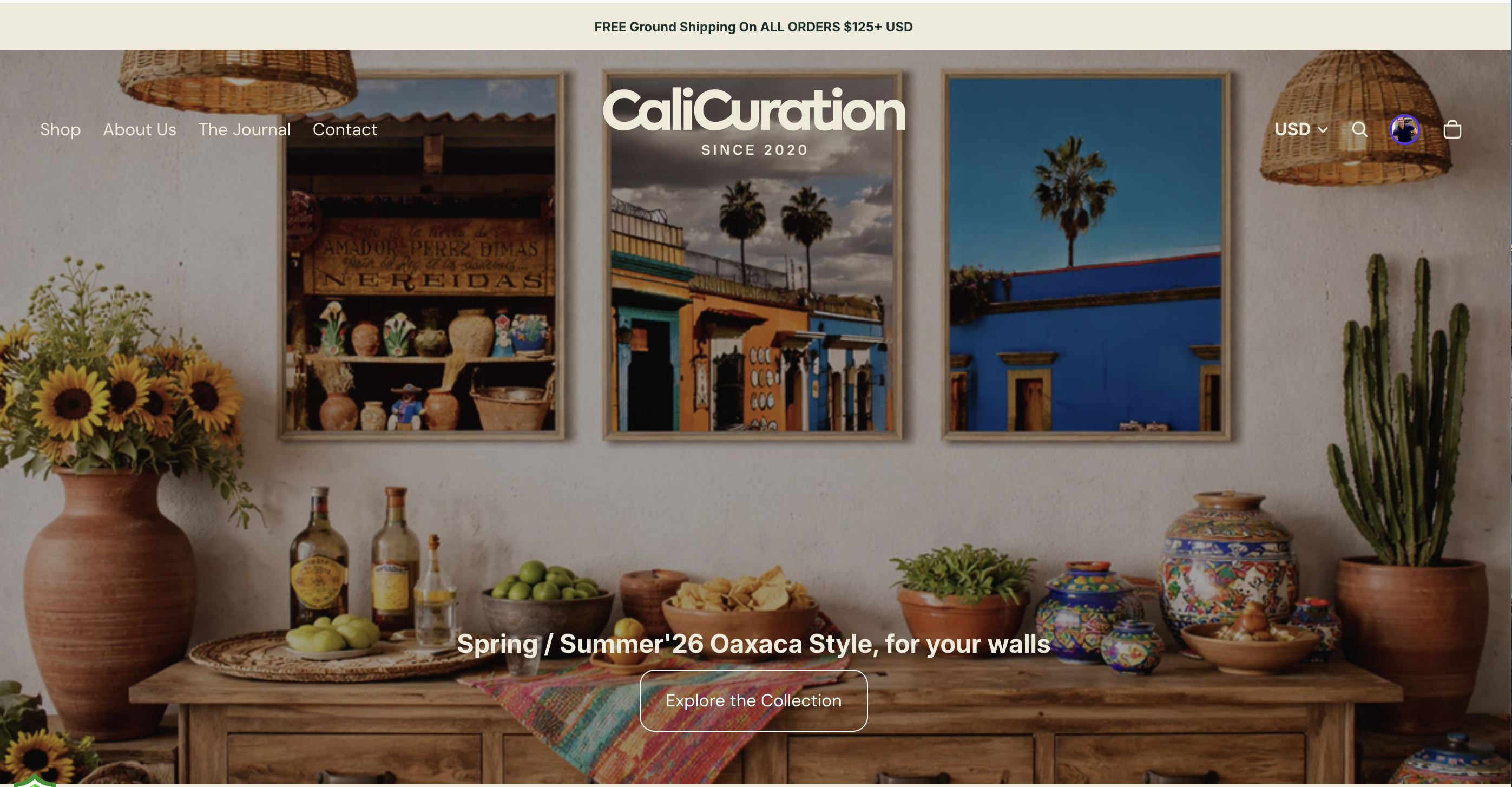
At Calicuration, every piece of wall art begins with a photograph taken in the field, coast to desert to city glow. The images are story-driven because a room that tells a story feels warmer than one that simply looks correct. If you are building a California-inspired space, the right piece of photography on your wall does what no throw pillow can: it anchors the room in a real place and a real feeling.
Explore the full California wall art collection to find prints and canvas pieces that bring the light, texture, and atmosphere of California into your home. Every order is custom-produced, and 5% supports community impact in Los Angeles and New York City.
FAQ
What defines California-inspired design?
California-inspired design, also called California Casual or California Modern, is a lifestyle-driven philosophy that prioritizes natural materials, warm neutral palettes, natural light, and seamless indoor-outdoor flow. It draws from Indigenous craft, Spanish Colonial architecture, Arts and Crafts traditions, and mid-century modernism.
Is California design the same as coastal or beach decor?
No. Authentic California-inspired home decor avoids themed coastal motifs entirely. It focuses on material honesty, earthy tones, and breathable spaces rather than nautical or beach-themed styling.
What materials are most common in California interiors?
White oak, natural stone, linen, jute, rattan, unlacquered brass, and organic ceramics are the most characteristic materials. They are chosen for their tactile warmth and natural origin, not their visual trend value.
What is the difference between California Casual and California Modern?
California Casual emphasizes relaxed warmth and layered natural textures. California Modern incorporates cleaner mid-century lines while keeping the same material palette and commitment to livability. Both reject stark minimalism and formal European styling.
How do I start decorating in the California style?
Begin with a warm neutral palette, introduce natural textiles and materials, and clear visual clutter from surfaces. Add one personal or unexpected piece, a piece of art, a handmade object, to give the space a collected, story-driven quality.