

There’s a quiet assumption that art gifts are reserved for a certain kind of person. The collector. The decorator. Someone with a gallery wall already in progress. But that assumption misses something real about why art gifts suit any occasion. A piece of wall art is not just decor. It’s a story held still in a frame, a memory made permanent, a reflection of how well you truly know someone. Whether you’re choosing art gifts for birthdays, weddings, or holidays, the right piece carries weight that a gift card simply cannot.
Table of Contents
Key takeaways
| Point | Details |
|---|---|
| Art signals genuine effort | The effort behind an art gift communicates care more powerfully than price alone. |
| Every occasion fits | From housewarmings to retirements, art can be tailored in scale, style, and subject to match any milestone. |
| Relationship context matters | Matching the investment level to your relationship stage prevents awkwardness and deepens connection. |
| Observation unlocks the right choice | Paying attention to a recipient’s space and tastes makes art selection feel personal, not presumptuous. |
| Lasting value outlives the moment | A well-chosen art gift lives in someone’s home for years, long after the wrapping paper is gone. |
Why art gifts resonate so deeply
Most gifts are chosen with the unwrapping moment in mind. Art gifts work differently. They ask you to think about where a piece will live, how it will feel in a room six months from now, and what it says about the person who receives it.
Psychologists call this the effort heuristic: humans naturally assign greater value to things that visibly required time, attention, and care. A curated print or a commissioned painting signals that you did not just click “add to cart.” You thought about color, mood, and meaning. That effort reads as love.
Art gifts also function as what researchers call an identity claim. When you give someone a piece that reflects their personality, their travels, their aesthetic sensibility, you are essentially saying: I see you clearly. That recognition is rare. It strengthens bonds in a way that a generic present simply cannot.
The risk, of course, is getting it wrong. Studies show that 16% of gifts damage relationships due to perceived mismatch. A piece that clashes with someone’s home or reflects your taste rather than theirs can feel tone-deaf. The solution is not to avoid art gifts. It’s to pay closer attention before you choose.
Here’s what makes art gifts emotionally powerful when chosen well:
-
They require visible effort and thoughtfulness, which recipients feel and remember.
-
They reflect the giver’s attunement to the recipient’s identity and world.
-
They carry a story, whether it’s a landscape from a shared trip or a color palette that mirrors a cherished room.
-
They live in the recipient’s space daily, becoming part of how they experience home.
Pro Tip: Before choosing any art gift, spend five minutes thinking about the recipient’s home. What colors dominate their walls? What subjects do they photograph or share online? That five minutes will tell you more than any gift guide.
Art gifts for all occasions
One of the most convincing arguments for why art gifts suit any occasion is their sheer flexibility. You can scale them up or down, commission them or choose ready-made, go abstract or deeply personal. No other gift category offers that range.
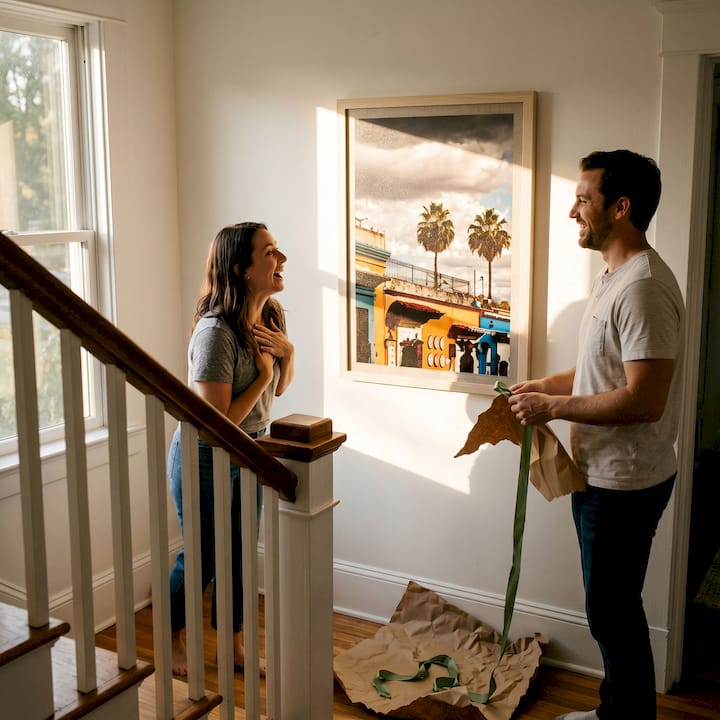
Here’s how art gifts map naturally across the occasions you’re most likely to face:
| Occasion | Art gift approach | Ideal scale |
|---|---|---|
| Wedding | Landscape of a meaningful place, custom portrait | Medium to large canvas |
| Birthday | Print reflecting a hobby, travel memory, or color preference | Small to medium print |
| Housewarming | Architectural or nature print that suits the new space | Medium canvas or framed print |
| Retirement | Commission reflecting career, travel, or personal legacy | Custom commission |
| Holiday | Curated print set, seasonal landscape, or abstract piece | Small prints or gift sets |
| Graduation | City print of where they studied, or an aspirational landscape | Medium print |
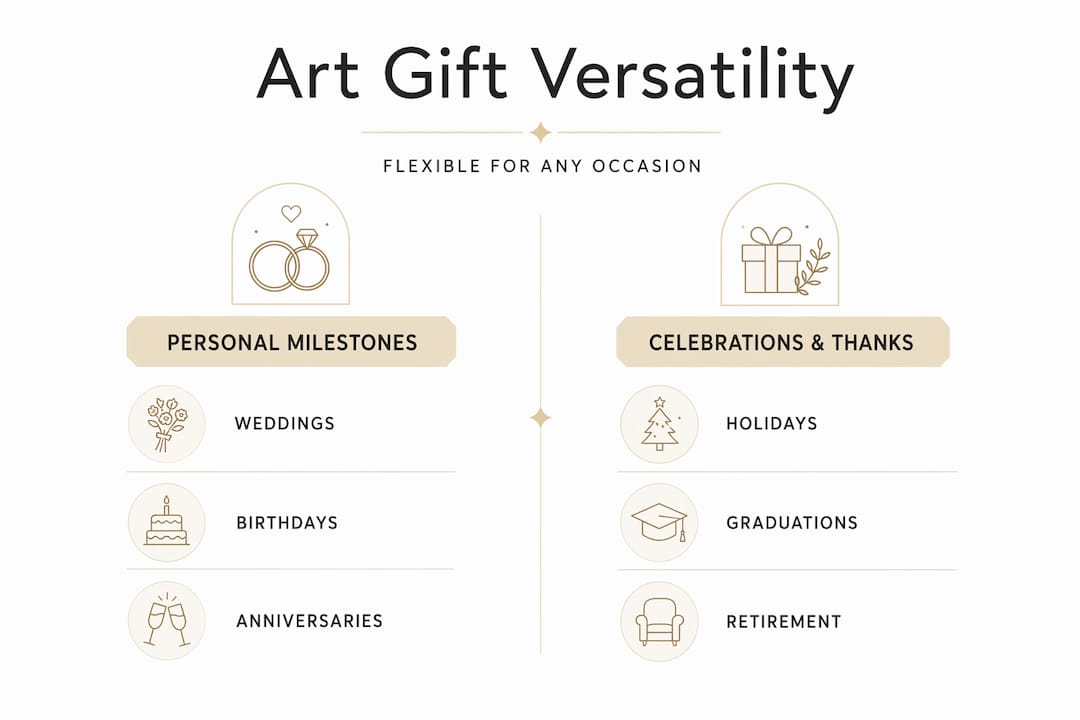
The commissioning timeline matters when you’re planning ahead. Custom portraits typically cost $75 to $800 and take one to six weeks, while larger commissioned paintings can range from $400 to $5,000 or more with lead times of four to twelve weeks. Ready-made prints and canvas art are available immediately and still carry tremendous meaning when chosen with care.
A few practical considerations for matching art to the occasion:
-
Weddings: Choose a subject that belongs to both people, a place they love together, or a landscape from their home region.
-
Birthdays: Lean into the recipient’s personal aesthetic. A coastal print for the person who always talks about the ocean. A city glow scene for the one who lives for urban energy.
-
Housewarmings: Think about the new space. A piece that suits the light, the wall size, and the mood of the room will feel intentional rather than incidental.
-
Holidays: A curated print from a collection like Calicuration’s travel photography wall art offers warmth and story without feeling overly personal for broader gatherings.
The beauty of art gifts for all occasions is that you are not locked into one style or price point. You can find something that feels right whether you’re spending $50 or $500.
The cultural and social weight of giving art
Gift-giving has always been more than an exchange of objects. Anthropologist Marcel Hénaff’s work frames gifts as social acts forming moral order, expressions of mutual recognition and cultural solidarity. When you give someone art, you are participating in something much older and richer than a transaction.
“Gift exchange is a symbolic language expressing social respect, status, and emotional connection rather than mere transaction.” — Psychology Today
Art gifts carry this symbolic weight particularly well because they communicate taste, attention, and respect for the recipient’s interior world. A thoughtfully chosen print says: your home matters, your story matters, and I paid attention to both.
There’s also a neurological dimension worth understanding. Gift exchange activates dopamine and oxytocin in the brain, strengthening bonds through pleasure, empathy, and trust. The act of giving art, with its visible effort and personal resonance, amplifies these effects in ways that a purely functional gift does not.
Cross-cultural nuances matter here too. In many Asian cultures, the ritual of presentation, the wrapping, the care in delivery, adds layers of meaning beyond the object itself. An art gift, presented with a handwritten note explaining the choice, honors this instinct across cultures. The story behind the piece becomes part of the gift.
Art gift best practices for any occasion
Choosing art well is less about having perfect taste and more about paying genuine attention. These steps will help you move from uncertainty to confidence.
-
Observe before you choose. Walk through the recipient’s home, or look at photos of their space. Note the dominant colors, the existing art if any, and the overall mood. A minimalist home calls for clean lines and neutral tones. A warm, layered space welcomes richer textures and deeper hues.
-
Match investment to relationship stage. Over-investing in art gifts early in a relationship can create an unintended sense of obligation. A $40 print for a coworker’s birthday feels generous and thoughtful. A $600 commission for someone you’ve known three months can feel overwhelming for both parties.
-
Decide between ready-made and commissioned. Ready-made art, like the pieces in Calicuration’s best-selling collections, is available immediately and still deeply personal when chosen with care. Commissioned pieces take longer and cost more, but they carry a one-of-a-kind quality that suits milestone occasions like anniversaries or retirements.
-
Think beyond the unwrapping moment. Research on gift psychology shows that givers often optimize for the reveal rather than the long-term integration of the gift into daily life. Ask yourself: will this piece still feel right in their home six months from now?
-
Write a note that tells the story. Explain why you chose this specific piece. What did it remind you of? What did you hope it would bring to their space? That note transforms a beautiful print into a lasting memory.
-
Present it with care. Wrap it well. Include a card. If you are giving a digital gift card toward a commission, print it and present it in an envelope with a handwritten description of what the recipient could choose.
Pro Tip: If you genuinely cannot read the recipient’s taste, listening for subtle cues in their everyday conversation will tell you more than asking directly. People describe what they love all the time without realizing it.
My perspective on art gifts and lasting connection
I’ve watched people give expensive gifts that disappeared into a drawer within a week. And I’ve seen a $60 print become the centerpiece of someone’s living room for years. The difference was never price. It was accuracy.
What I’ve come to believe is that art gifts succeed where others fail because they demand something from the giver. You cannot choose a piece of art thoughtlessly. You have to look at it, sit with it, and ask: does this feel like them? That act of consideration is itself a form of love.
The perfect gift paradox is real. We sometimes think that a bigger, more extravagant gift signals more care. But in my experience, the gifts that land hardest are the ones that show you were paying attention. A coastal print chosen because you remembered someone saying they grew up near the water. A city glow piece selected because it mirrors the view from their first apartment. Those choices carry a weight that no price tag can replicate.
Art also does something quietly remarkable. It holds both the giver’s and the recipient’s identities in one frame. The giver’s taste in choosing it, the recipient’s world in receiving it. That dual reflection is what makes a well-chosen piece feel like it was always meant to be there.
— Info
Find the right piece at Calicuration
Calicuration was built around the idea that a space should feel like a memory map, collected and warm, full of stories worth telling. Every piece in the collection is shot by the founder and produced on demand, so what arrives at your door is specific, considered, and made to last. Whether you’re looking for art gifts for birthdays, weddings, or the holidays ahead, the range spans coast light, desert quiet, city glow, and architectural stillness.
Browse the full wall art collection to find something that fits the occasion and the person. If you want something with a particular mood or palette, the studio edition canvas pieces are a strong starting point. And because 5% of every order goes toward community impact in Los Angeles and New York City, giving a Calicuration piece means giving twice.
FAQ
Why do art gifts work for so many different occasions?
Art gifts are flexible in scale, style, and subject matter, making them adaptable to nearly any milestone or celebration. Their emotional resonance comes from the effort and attunement they signal, which translates across occasions from weddings to housewarmings to holidays.
How do I choose art that matches the recipient’s taste?
Observe their existing space and note colors, moods, and subjects they’re drawn to. Listening for subtle cues in everyday conversation is often more revealing than asking directly.
Is commissioned art worth it for a gift?
For milestone occasions like anniversaries, retirements, or weddings, a commissioned piece carries a one-of-a-kind quality that ready-made art cannot replicate. Lead times range from one to twelve weeks and costs vary widely, so plan ahead.
Can art gifts feel too personal or presumptuous?
Yes, if the scale of investment does not match the relationship stage. A modest, well-chosen print is almost always welcome. A large commissioned piece is best reserved for close relationships and significant milestones.
What makes art a better gift than something functional?
Functional gifts serve a need and then fade into the background. A well-chosen art piece lives on a wall for years, becoming part of how someone experiences their home every single day. That daily presence is what gives art gifts their lasting emotional value.