

Table of Contents
- What to Look For in Curated Photography Alternatives
- Fine Art Photography Prints: Materials, Framing, and Quality
- How to Style Photography Prints in Your Home
- Budget-Tier vs. Luxury-Tier Curated Photography
- Sustainability and Material Sourcing in Modern Art
- Comparing Curated Photography Options at a Glance
- Conclusion
- Frequently Asked Questions
Last Updated: September 25, 2026
What to Look For in Curated Photography Alternatives
Curated photography is the practice of hand-selecting original photographic works, then producing them as gallery-grade prints and presenting them as a cohesive collection rather than a random assortment of images. At CaliCuration, we build ours from founder-shot travel photography, so every piece traces back to a real place and a real moment.
- Original capture, not stock. Ask whether the photographer shot the image or licensed it. Stock imagery is everywhere, and it shows.
- Archival materials. Prints on acid-free paper or rigid substrates resist yellowing far better than standard poster stock.
- Framing included or clearly specified. Framing is the step most buyers underestimate.
- Made-to-measure sizing. Awkward walls need custom dimensions, not the three sizes a warehouse happens to stock.
- A stated give-back. If a brand claims charitable giving, the details should be easy to find.
Fine Art Photography Prints: Materials, Framing, and Quality
Fine art photography prints are photographic images produced to gallery standards, meaning the paper, ink, and mounting are chosen to hold color and detail for decades rather than months. The material decision matters more than the megapixel count.
Archival Paper and Mounting Options
Archival paper is paper manufactured to be acid-free and lignin-free, so it does not break down or discolor the image over time. Mounting is how the print attaches to its backing, and it changes both the look and the lifespan.
Three mounting routes dominate:
Mounting Option |
Look |
Best For |
Watch Out For |
|---|---|---|---|
Classic, warm |
Living rooms, hallways |
Glass glare in bright rooms |
|
Aluminum print |
Modern, frameless |
Minimalist and office spaces |
Less forgiving of very warm interiors |
Canvas |
Soft, textured |
Casual, coastal rooms |
Softer detail than paper |
How to Style Photography Prints in Your Home
Styling photography prints works best when the artwork leads and the room follows. Pick the print first, then let its palette dictate the surrounding textures. The rules below hold up whether you are dressing a single wall or building a slow, collected gallery over a few seasons.

The Rules That Actually Hold Up
- Match scale to wall, not to furniture. A print should fill roughly two-thirds of the wall width above a sofa. On a narrow wall, one tall vertical piece beats three small squares.
- Keep the palette quiet. Let the photograph carry the color. Neutral walls make a sunset print feel intentional rather than loud.
- Mix one color piece with black-and-white. A single monochrome print calms a room that risks feeling busy.
- Hang at eye level. The center of the artwork should sit around 57 to 60 inches from the floor, which is the museum convention most installers still use.
- Leave breathing room. Aim for two to three inches between frames in a grouping so each image reads as its own moment.
Room-by-Room Pairings
The subject should match the room's job, not just its color scheme.
- Living room. A wide landscape or coastal scene anchors a sofa wall and gives the eye somewhere to rest.
- Bedroom. Soft, low-contrast travel photography, mist, still water, quiet streets, reads calmer than high-saturation sunsets.
- Kitchen and entry. Vibrant color and architectural detail hold their own against busy surfaces and foot traffic.
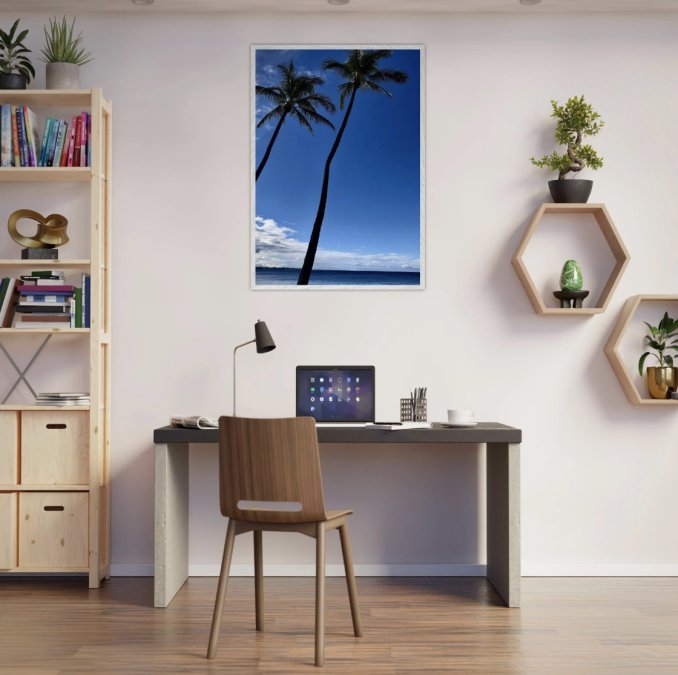
- Home office. A single architectural or street photograph above the desk keeps the wall focused without competing with screens.
- Hallway. Vertical pieces in a row turn a narrow pass-through into a small gallery.
Styling for Gifting and Seasonal Refresh
A framed print is one of the few gifts that works for a housewarming, a wedding, or a milestone birthday without needing to know the recipient's size. The trick is to choose a place, not a trend: a city they lived in, a coastline they return to, a landscape that matches their travel stories. Because our pieces are made to order in multiple sizes and finishes, a gift can be sized to a specific wall rather than guessed at.
Choosing a Print for a Specific Wall
Measure the wall before you browse. Odd dimensions are the most common reason people end up with art that never gets hung. Note the width, the height, and how much furniture sits below it.
Framing Choices That Change the Look
The frame is the quietest styling decision and the one people notice last. A thin black or natural wood frame disappears and lets the image lead. A wider frame adds weight and suits traditional rooms. Frameless aluminum prints push a space modern and work especially well in kitchens, offices, and anywhere glass glare would be a problem. If you are unsure, choose the frame that matches the room's existing hardware, door handles, light fixtures, cabinet pulls, and the piece will look like it was always meant to be there.
Budget-Tier vs. Luxury-Tier Curated Photography
The real difference between budget and luxury curated photography is not the image. It is the production chain around it: paper weight, mounting method, frame material, and how much of the process is automated.
Sustainability and Material Sourcing in Modern Art
Sustainability in wall art comes down to three things: what the print is made of, how it is produced, and how far it travels. Print-on-demand reduces waste because nothing is manufactured before someone wants it.
Comparing Curated Photography Options at a Glance
Most guides to curated photography alternatives are written by the brands they recommend, which makes them hard to trust. What is missing from the search results is a neutral way to compare options on the criteria that actually predict whether you will still love the print in five years. So instead of ranking names, here is how the main routes stack up against the questions that matter.
The Criteria That Separate Real Options
Before comparing anything, decide which of these you actually care about. Most buyers weight two or three heavily and ignore the rest.
- Capture. Was the photograph shot by the seller, or licensed from a stock library? Original capture is the single strongest signal that the "curation" is real.
- Materials. Acid-free, lignin-free paper or a rigid substrate like aluminum will outlast standard poster stock by years.
- Framing. Is framing included, specified clearly, or left for you to arrange? This is the step buyers most often underestimate.
- Sizing. Fixed warehouse sizes versus made-to-measure dimensions for awkward walls.
- Production model. Made-to-order reduces waste but rules out same-day shipping. Mass-produced is faster but less personal.
- Transparency. Can the seller tell you who took the image and where? Vague answers usually mean a print-on-demand catalog behind a curation label.
How the Main Routes Compare
Route |
Capture |
Materials |
Framing |
Sizing |
Production Model |
|---|---|---|---|---|---|
Mass marketplace |
Licensed or mixed |
Varies widely |
Usually not included |
Fixed sizes |
Mass-produced |
Stock print shop |
Stock library |
Standard poster stock |
Buyer arranges |
Limited |
Mass-produced |
Print-on-demand catalog |
Mixed or licensed |
Varies |
Often not included |
Multiple sizes |
Made to order |
Original-photography collection |
Shot by the seller |
Archival paper or rigid substrate |
Framed and aluminum options |
Made to measure |
Made to order |
The Trade-Offs Nobody Puts in the Table
Every route above is a real trade, not a ranking.
- Selection versus story. A marketplace with millions of images will always have more raw options. What it will not have is a photographer who can tell you where each frame came from. Fewer choices, better ones, is the trade most buyers eventually make.
- Speed versus intent. Made-to-order production means no same-day shipping. In exchange, nothing is manufactured before someone wants it, which cuts waste and means you are not sharing an image with a thousand other living rooms.
- Price tier versus longevity. Budget tier typically means poster stock, a thin frame, and standard sizing, fine from across the room, less fine up close. Luxury tier means archival materials, rigid mounting, custom dimensions, and framing handled before shipping. You pay for longevity and for the removal of decisions. A well-made mid-tier piece often outlasts a cheap luxury-labeled one, so weigh materials over the label.
- Neutrality versus convenience. A single retailer that handles capture, framing, and sizing removes the most decisions, but it also narrows your options. Buying piece by piece across sellers gives you more control and more work.
A Quick Way to Decide
If you want fast, low-cost filler art, a mass marketplace is the honest answer. If you want a piece that traces back to a real place and a real moment, and you are willing to wait for it to be made, an original-photography collection is the better fit. The question that filters most options is simple: can the seller tell you who took the photograph and where?
Compare options on capture, materials, framing, and sizing, not on catalog size. A smaller collection with a real photographer behind it will almost always outlast a larger one with no story. ::: Intentional presentation elevates these curated works, as bespoke framing services provide the necessary structural integrity to ensure that the narrative of a print remains preserved for years to come.
Conclusion
The hardest part of buying art online is trusting that what arrives matches what you saw. That gap is real, and it is why materials, framing, and production transparency matter more than browsing volume.
Frequently Asked Questions
What should I look for when buying fine art photography prints online?
Check the print materials first. Archival paper, canvas, or aluminum keep colors true for years. Look for framed or mounted options so the piece arrives ready to hang. Also confirm the image is original, not stock or AI. At CaliCuration, every print starts with founder-shot travel photography and comes in multiple sizes, so you can match the piece to your wall.
How do I choose photography that fits my home's aesthetic?
Start with the mood you want. Warm, sunlit scenes suit coastal or Mediterranean styles, while black-and-white prints work in minimalist or Nordic rooms. Measure your wall first, then pick a print size that leaves breathing room. If you are unsure, order a smaller size and build a gallery wall around it. Our collection includes both vibrant and monochrome options.
What is the difference between mass-produced prints and curated photography?
Mass-produced prints are often stock images reproduced in large batches. Curated photography is selected for a specific story, place, or feeling, and printed in smaller runs. That means your piece is less likely to appear in a neighbor's home. It also usually comes with better materials and framing. The trade-off is a higher price per print, but the piece lasts longer and feels more personal.
Are there alternatives to large-scale art retailers for unique photography?
Yes. Independent studios and online galleries often carry original travel and landscape photography you will not find in big-box stores. These sellers usually offer made-to-measure sizes, eco-friendly materials, and a portion of sales going to charity. Look for clear product details, real customer photos, and a stated give-back commitment. That combination gives you a unique piece and a story behind it.