

Table of Contents
- Why Affordable Framed Prints Belong in Every New Home
- How to Choose Wall Art for Living Room Spaces
- Gallery Wall Layout Ideas That Work in Any Floor Plan
- Our Favorite Affordable Framed Prints for New Homes
- Tips for Hanging Framed Prints Without Damaging Walls
- Budget-Friendly Ways to Style Prints Throughout a New Home
- What Sets Our Prints Apart
- Frequently Asked Questions
Last Updated: September 16, 2026
Why Affordable Framed Prints Belong in Every New Home
Moving into a new place comes with a long list of expenses, and wall art often lands at the bottom of it. That's a mistake. Affordable framed prints for new homes solve two problems at once: they cover bare walls without wrecking your budget, and they arrive ready to hang, which matters when you're still living out of boxes.
How to Choose Wall Art for Living Room Spaces
Choosing wall art for a living room starts with two questions: what colors already live in the room, and how much wall are you actually filling? Answer those before you browse, and the shortlist builds itself.
Matching Art to Your Room's Existing Palette
Pull one or two colors from your sofa, rug, or curtains and look for prints that echo them. A coastal print with soft blues and warm sand tones sits easily above a neutral couch. A black and white countryside print holds its own against bold furniture without fighting it.
Sizing Rules That Keep a Large Wall From Feeling Empty
Art should take up roughly two-thirds to three-quarters of the width of the furniture below it. Above a standard sofa, that usually means a piece at least 30 inches wide, or a grouping of smaller prints. On a tall, narrow wall, stack two prints vertically instead of leaving a strip of bare paint.
Gallery Wall Layout Ideas That Work in Any Floor Plan
Gallery wall layout ideas live or die on one rule: pick a shape before you pick the art. Three arrangements handle almost every floor plan, whether you're working with a long hallway, a staircase, or one blank wall in an open-plan space.
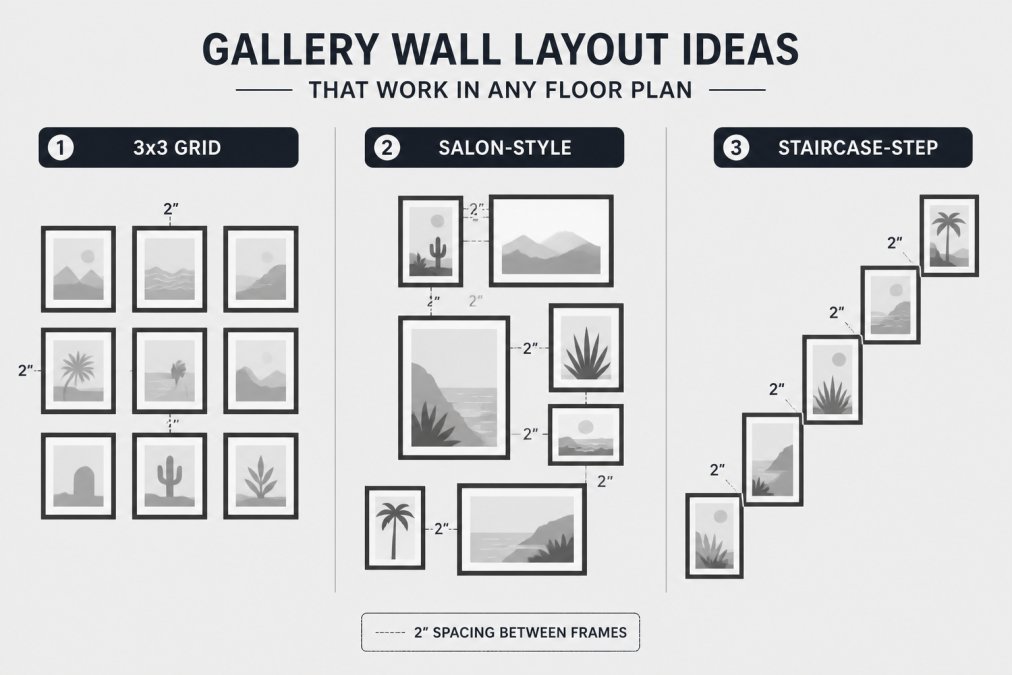
The Grid, the Salon, and the Staircase Arrangement
The grid keeps frames the same size in even rows and columns. It suits minimalist rooms and small collections. The salon style mixes sizes and staggers them around a center point, which works well when you want a collected, lived-in feel.
Our Favorite Affordable Framed Prints for New Homes
Every print below comes framed, ready to hang, and made to order, with multiple sizes and finish choices so you can match your wall rather than the other way around. Here's how we'd sort them by room and mood.
Coastal Calm: Long Island Sound Pier Framed Poster ($59)
A quiet pier stretching into calm water gives this one its endless-summer feel. It's the print we'd hang in a bedroom or bathroom where you want the room to slow down. The matte finish keeps glare low.
Desert Warmth: Palm Springs Framed Poster ($69)
Warm light, relaxed Southern California character, and a semi-gloss finish that gives colors a subtle lift. This is the pick for mid-century and desert-inspired rooms, and it pairs naturally with rattan, terracotta, and warm wood tones.
Urban Energy: NYC Brooklyn Bridge Framed Poster ($68)
Shot from DUMBO on a bright summer day, this one brings crisp city energy without feeling cold. The heavyweight matte poster and shatterproof plexiglass make it a practical choice for hallways and entryways.
Timeless Neutral: Cotswolds English Countryside Framed Poster ($69)
A black and white countryside scene in an ash wood frame. Because it has no color to clash with, it works in almost any palette, which makes it an easy fit for a home office.
Statement Scale: One World Trade Center Framed Canvas ($89)
Sunlight reflecting off the Manhattan skyline gives this framed canvas its scale. It's the largest-feeling piece here, so it suits the one big wall in a living room or above a bed where a poster would look undersized.
Price |
Best Room |
Palette |
|
|---|---|---|---|
Long Island Sound Pier |
$59 |
Bedroom, bathroom |
Soft blues, sand |
Palm Springs |
$69 |
Living room, den |
Warm earth tones |
NYC Brooklyn Bridge |
$68 |
Hallway, entryway |
Cool grays, brick |
Cotswolds Countryside |
$69 |
Home office, dining |
Black and white |
One World Trade Center |
$89 |
Living room, bedroom |
Bright sky, steel |
Tips for Hanging Framed Prints Without Damaging Walls
Hanging framed prints without damage comes down to three things: knowing your wall type, matching the hardware to the weight, and planning the holes before you make them. New-home walls are usually drywall over wood studs, and that changes what works.
Match the Hardware to the Weight and the Wall
A frame under about 5 pounds can hang on a single hardened steel nail driven at a 45-degree angle. Anything heavier needs an anchor. For drywall, a self-drilling hollow-wall anchor rated for 20 to 50 pounds is the standard choice, and it leaves a hole no bigger than a pencil eraser when you remove it.
Use the Two-Hook Method for Anything Wide
A frame wider than 16 inches should hang from two hooks, not one. Two points stop the frame from tilting and spread the load so the paper facing around a single nail can't tear. Space the hooks about one-third of the frame width apart, and run a taut string between them to check they're level before you commit.
Get the Height Right the First Time
The center of the art should sit at roughly 57 to 60 inches from the floor, which is the standard museum height and matches most people's eye line. Above a sofa, drop the bottom edge 6 to 10 inches above the backrest so the art and furniture read as one group rather than two floating objects.
Keep the Holes Minimal When You Rearrange
If you like to rotate art seasonally, plan for it. Choose one anchor point per wall and swap frames on the same hook, or use a picture rail or a removable adhesive strip rated for the weight. Removable strips work well for lightweight prints under about 4 pounds and come off clean on painted drywall, but they fail on textured walls and in humid rooms, so keep them out of bathrooms and above kitchens.
Budget-Friendly Ways to Style Prints Throughout a New Home
Decorating on a budget works best when you buy fewer, larger pieces instead of many small ones. One 24x36 print makes more visual impact than four 8x10s, and it usually costs less per square inch of wall covered. That math is the whole game: art budget divided by wall covered, not art budget divided by number of frames.
Buy the Big Piece First, Then Fill In
Start with the room you use most and hang one statement piece there before you buy anything else. A single large framed print anchors a wall and makes the rest of the room look intentional. Small prints scattered room to room read as clutter and cost more per square foot of wall than one big piece does.
Group Instead of Scatter
Group smaller prints into a single gallery wall rather than spreading them across the house. A tight grid of six 8x10s on one wall costs less than six separate frames on six walls, and it looks deliberate. Reuse the same frame finish throughout the house so the collection reads as one set rather than a series of unrelated buys.
Rotate Instead of Repurchase
Rotate prints seasonally rather than buying new art every year. Store the off-season pieces flat in a portfolio or a shallow box, and swap them when the mood shifts. A collection of eight prints rotated across four walls gives you sixteen looks for the price of eight.
The DIY Route: Frame It Yourself
This is the gap most buying guides skip. If you already own a print, a poster, or a digital file, framing it yourself can cut the cost of a finished piece substantially. Standard ready-made frames in common sizes like 11x14, 16x20, and 24x36 cost far less than custom framing, and a mat cut to size hides the difference between a standard frame and a custom one.
Digital Files vs. Physical Prints
If you're buying a digital download, you're paying for the file, not the paper. That's the cheapest entry point, but you then own the printing, the frame, and the assembly. A physical framed print costs more up front but arrives ready to hang with no extra steps.
Print-on-Demand Keeps Prices Down
Print-on-demand means your piece is produced when you order it, so there's no unsold inventory to absorb into the price. That's why made-to-order framed prints often cost less than mass-produced ones sitting in a warehouse.
What Sets Our Prints Apart
Every CaliCuration print starts as an original photograph, shot by our founder on real trips rather than staged for a catalog. No stock images, no AI-generated scenes, no reused files. When you order a print from us, you're getting a moment that hasn't been published anywhere else.
Frequently Asked Questions
How do I choose the right size framed print for a wall?
Measure your wall width and aim for art that fills 60 to 75 percent of it. For a sofa wall, the art should span roughly two-thirds the width of the furniture below. A single large piece works well on narrow walls, while a group of smaller prints suits wide, open spaces. Our framed posters come in multiple sizes, so you can scale up or down depending on the room.
What are the best ways to hang framed prints without damaging walls?
Our ready-to-hang frames include mounting hardware, so you only need a nail or hook.
How can I mix different art styles in a new home?
Pick a unifying thread, such as a shared frame finish, a limited color palette, or a common theme like travel. Pair a black and white countryside print with a vibrant coastal poster by keeping both in similar wood frames. Group them by mood rather than by subject. We suggest starting with two or three pieces and adding more as you settle into the space.
Are affordable framed prints a good investment for home decor?
Framed prints offer strong visual impact for the price. Our ready-to-hang pieces start at $59, which is far less than original paintings or custom commissions. They let you refresh a room seasonally or after a move without a big spend. Because each print is made to order on archival materials, it holds its color and structure over time.
What is the best way to arrange a gallery wall in a living room?
Start with the largest piece as your anchor, then arrange smaller prints around it. Keep 2 to 3 inches of space between frames for a clean look, or 1 to 2 inches for a tighter salon style. Lay the arrangement on the floor first to test the balance.